Send Personalized Workout Plans via WhatsApp

Watch Step By Step Video Tutorial Below


1. Accessing Pabbly Connect for Integration

To start integrating Click with Salesforce CRM, you need to access Pabbly Connect. Open a new tab and search for Pabbly Connect. Once on the landing page, you will see options to sign in or sign up.

If you are a new user, click on the “Sign up free” button to create your account. Existing users can log in directly. After signing in, click on the “Access Now” button under Pabbly Connect to enter the dashboard.


2. Creating a Workflow in Pabbly Connect

In this section, we will create a workflow that automates the lead capture process. Click on the “Create Workflow” button in the dashboard of Pabbly Connect. You can either create a workflow from scratch or use AI to assist you.

  • Select the AI option to help create the workflow.
  • Paste the title and use case for your workflow.
  • Send this information to the AI for analysis.

The AI will generate a template for your workflow, which includes the necessary applications and actions. Approve the template to proceed to the next step.


3. Integrating Click with Salesforce CRM

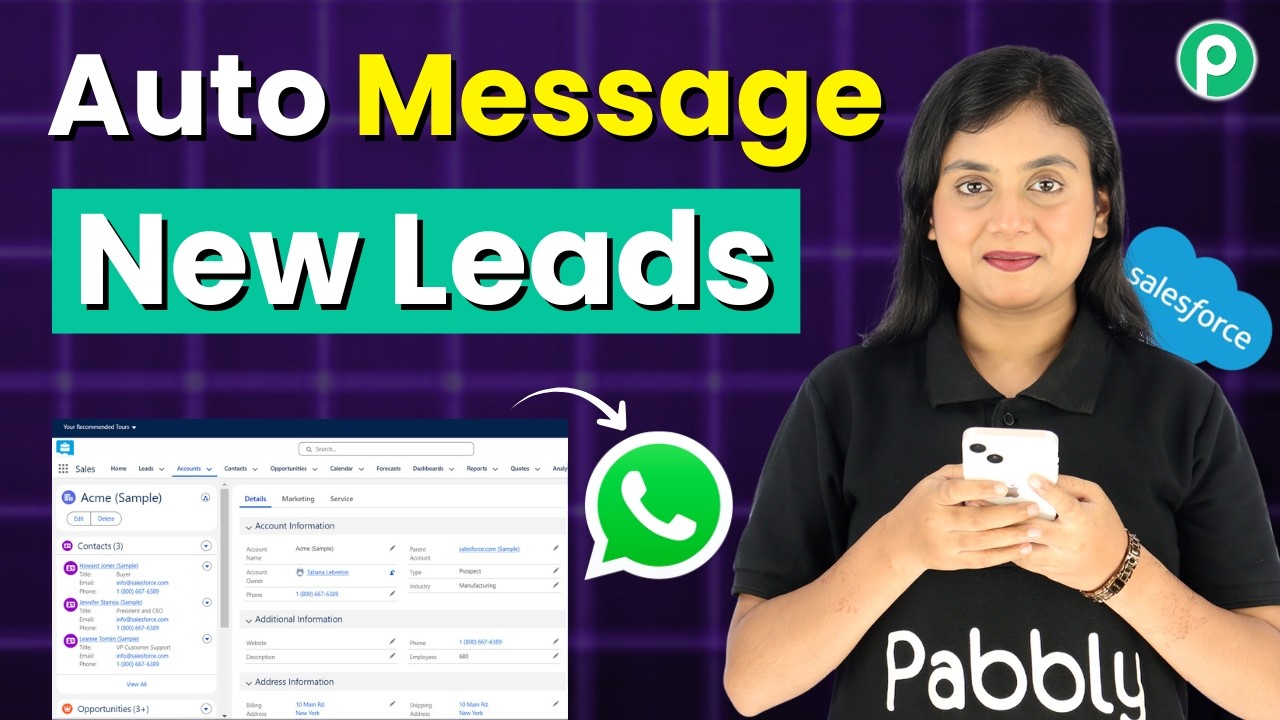
Now, let’s integrate Click with Salesforce CRM using Pabbly Connect. First, choose Click as your trigger application and select the event that triggers the workflow when a new entry is received.

Next, select Salesforce CRM as the action application and choose the “Create Lead” action. This will allow Pabbly Connect to automatically create a lead in Salesforce whenever a new form submission occurs.

  • Connect to Salesforce by clicking the “Connect” button.
  • Authorize Pabbly Connect to access your Salesforce account.
  • Map the fields from Click to Salesforce to ensure data accuracy.

After mapping the fields, save the workflow, and you will see that leads are being created in Salesforce automatically.


4. Generating Personalized Workout Plans with OpenAI

In this step, we will use OpenAI to generate personalized workout plans for the leads captured through Click. OpenAI will be integrated into the workflow using Pabbly Connect.

Click on the “Add New Connection” for OpenAI and enter your API key to connect. Once connected, select the AI model you want to use for generating responses. You can choose GPT-4 or any other model available.

  • Create a prompt for the AI that specifies the details for the workout plan.
  • Map the required fields from Click to the prompt.
  • Test the connection to ensure the AI generates a response.

Once the response is generated, it will be used in the next step to send a message to the lead.


5. Sending Workout Plans via WhatsApp Using Pabbly Chatflow

The final step is to send the generated workout plan to the lead via WhatsApp. For this, you will use Pabbly Chatflow integrated through Pabbly Connect.

Connect to Pabbly Chatflow by adding a new connection and entering your API token. Once connected, you can specify the recipient’s WhatsApp number, the generated workout message, and the lead’s name.

  • Map the WhatsApp number and message content from OpenAI.
  • Test the message sending to ensure it delivers correctly.
  • Save and finalize your workflow.

Now, every time a lead submits their details through Click, they will receive a personalized workout plan instantly via WhatsApp, enhancing their onboarding experience.


Conclusion

By integrating Click with Salesforce CRM using Pabbly Connect, you can automate your lead management process. This setup ensures that leads receive personalized workout plans instantly, significantly improving engagement and conversion rates.

Automatically Share Every YouTube Upload to Discord

Watch Step By Step Video Tutorial Below


1. Accessing Pabbly Connect for Integration

To integrate YouTube with Discord, you first need to access Pabbly Connect. If you’re a new user, search for pabbl.com/connect in your browser and open the landing page.

Once on the Pabbly Connect page, click on the ‘Sign Up for Free’ option in the top right corner. This will allow you to explore Pabbly Connect with 100 free tasks every month, enabling you to test the integration process without any costs.


2. Creating a Workflow in Pabbly Connect

After signing up, you can start creating your workflow in Pabbly Connect. This workflow will connect YouTube and Discord seamlessly. Click on the ‘Add New Workflow’ button to begin.

  • Select YouTube as the trigger application.
  • Choose the event as ‘New Video in Channel’.
  • Click on ‘Connect’ to link your YouTube account.

Once you select the YouTube account, Pabbly Connect will prompt you to sign in with your Google account. Ensure you grant the necessary permissions for seamless integration.


3. Setting Trigger Parameters in Pabbly Connect

Next, you’ll need to set the trigger parameters in Pabbly Connect. This step is crucial as it defines how often the trigger checks for new data from YouTube.

To adjust the trigger time, click on the YouTube application within your workflow. You can set the minimum time to check for updates every 10 minutes or up to 24 hours. For this integration, a setting of 90 minutes is recommended.

  • Click ‘Save’ after setting the trigger time.
  • Test the trigger by clicking ‘Save and Send Test Request’.

This will capture the latest video details, including the video URL, which will be used in the next steps of your workflow.


4. Notifying Discord about New YouTube Videos

Now that you have set up the trigger, the next step involves notifying your Discord channel about new YouTube uploads using Pabbly Connect.

Add a new action step and select Discord as the action application. Choose ‘Send Channel Message’ as the event. You can opt for either HTML or markdown format based on your preference.

  • Open your Discord server settings to create a new webhook.
  • Copy the webhook URL and paste it into Pabbly Connect.

Once you have pasted the webhook URL, you can customize the message to include the video title and URL. Use the mapping feature in Pabbly Connect to dynamically insert these details from the previous step.


5. Finalizing Your Integration and Testing

After setting up the message format in Pabbly Connect, it’s time to finalize your integration. Make sure all details are correctly mapped and configured.

Click on ‘Save and Send Test Request’ to test the workflow. If everything is set up correctly, your Discord channel will receive a message alerting the team about the new YouTube video upload.

  • Check your Discord channel for the notification.
  • Adjust the trigger timing based on your video posting schedule.

With this setup, your team will be notified automatically whenever you upload a new video on YouTube, streamlining your communication process.


Conclusion

Using Pabbly Connect, you can effortlessly integrate YouTube with Discord to automate notifications for new video uploads. This saves time and ensures your team stays updated with the latest content.

Bulk WhatsApp Marketing Automation using Pabbly Chatflow (No Code)

Watch Step By Step Video Tutorial Below


1. Accessing Pabbly Connect for WhatsApp Messaging

To start the process of sending bulk WhatsApp messages, first, you need to access Pabbly Connect. Open your browser and navigate to the Pabbly Connect homepage.

Once there, you can either sign up for a new account or log in if you are an existing user. This is crucial for setting up your WhatsApp messaging automation.


2. Setting Up Your WhatsApp Number in Pabbly Connect

After logging into Pabbly Connect, navigate to the Pabbly Chartflow dashboard. Here, you will need to connect your WhatsApp number to the platform.

  • Click on the ‘Add WhatsApp Number’ button.
  • Choose your preferred method for connecting your WhatsApp account.

This setup is essential for sending messages to your customers through Pabbly Connect. Once connected, you can proceed to create message templates.


3. Creating Message Templates for WhatsApp

In this section, you will create a message template that will be used for the WhatsApp broadcast. Navigate to the template section in Pabbly Connect.

Here, you can add a new template by clicking on the ‘Add Template’ button. You can choose to create a template using AI or manually input your message.

  • Name your template, e.g., “New Product Launch”.
  • Draft your message, ensuring it includes personalized variables.

Once your template is approved by Meta, you can use it for your broadcast messages. This feature allows for the personalization of each message sent through Pabbly Connect.


4. Sending Bulk WhatsApp Messages with Pabbly Connect

Now, to send your bulk WhatsApp messages, go to the broadcast section in Pabbly Connect. Click on the ‘Add’ button to create a new broadcast campaign.

Here, you will select the type of broadcast, name it, and choose your contact list. Make sure to upload your contacts from a CSV file that you exported from Google Sheets.

  • Select the contact list you want to send messages to.
  • Choose whether to use a pre-approved template or a regular message.

Once everything is set, you can test the broadcast before sending it out to ensure everything works as expected through Pabbly Connect.


5. Scheduling Your WhatsApp Broadcast

After testing, you can schedule your WhatsApp broadcast in Pabbly Connect. Decide whether you want to send the message immediately or at a later date.

To schedule, select the desired date and time for the broadcast. Ensure that you choose a future date to avoid sending messages instantly.

Once scheduled, you can view the stats of your broadcast, such as sent, delivered, and failed messages. This feature allows you to manage your communications effectively using Pabbly Connect.


Conclusion

In summary, using Pabbly Connect for bulk WhatsApp messaging allows you to send personalized messages efficiently. By following the steps outlined, you can automate your messaging process seamlessly.

Automate Your Entire Business on WhatsApp in 10 Minutes (No Coding) 🚀

Watch Step By Step Video Tutorial Below


1. Accessing Pabbly Connect for WhatsApp Automation

To start automating your business with WhatsApp, the first step is accessing Pabbly Connect. Open a new tab and navigate to Pabbly’s official site. Here, you can either sign up for a free account or log in if you’re an existing user.

Once logged in, go to the Pabbly Connect dashboard. This is where you will create your automation workflows. Make sure to familiarize yourself with the interface, as it will be crucial for setting up your WhatsApp integration.


2. Creating Your WhatsApp Chatbot with Pabbly Connect

Next, you will create a WhatsApp chatbot using Pabbly Connect. Click on the “Add Flow” button to start building your chatbot. You will need to name your flow, such as “Automate Your Entire Business on WhatsApp in 10 Minutes.” This name will help you identify the flow later.

  • Select a trigger event, such as “Keyword” for your chatbot.
  • Enter keywords like “hi” or “hello” to initiate the conversation.
  • Set up welcome messages to greet users automatically.

By linking these triggers and responses, Pabbly Connect allows your chatbot to interact with users effectively. Make sure to save your flow regularly to avoid losing any progress.


3. Customizing Chatbot Responses in Pabbly Connect

After setting up the initial flow, it’s time to customize your chatbot’s responses. Using Pabbly Connect, you can create personalized messages based on user inputs. For example, after a user sends their first name, you can respond with a message like, “Hello, [First Name]! Welcome to Bright Future Academy.” This personalization enhances user experience.

To achieve this, utilize the “Ask a Question” feature to gather user information:

  • Ask for the user’s first name and last name.
  • Request additional details like the type of courses they are interested in.
  • Use dynamic fields to personalize responses based on user input.

This ensures that the interaction feels more human and tailored, making your WhatsApp chatbot more effective in engaging users.


4. Integrating Salesforce with Pabbly Connect

To enhance your automation further, you can integrate Salesforce with Pabbly Connect. This integration allows you to automatically create contacts in Salesforce based on leads generated through your WhatsApp chatbot. Start by adding an API request node in your flow.

Follow these steps to set up the integration:

  • Select the Salesforce API as your destination.
  • Map the fields from your WhatsApp chatbot to the corresponding fields in Salesforce.
  • Test the integration to ensure that contacts are being created correctly.

This integration streamlines your lead management process, allowing your business to respond to inquiries promptly and efficiently.


5. Conclusion: Automate Your WhatsApp Business with Pabbly Connect

In summary, using Pabbly Connect to automate your WhatsApp business can significantly enhance your customer interaction. By setting up a chatbot and integrating it with Salesforce, you can manage leads effortlessly and provide immediate responses to inquiries.

This guide detailed the steps to access Pabbly Connect, create a WhatsApp chatbot, customize responses, and integrate with Salesforce. Implement these strategies to improve your business operations and customer satisfaction.

Send WhatsApp Promotions & Log Razorpay Sales (Full Setup)

Watch Step By Step Video Tutorial Below


1. Accessing Pabbly Connect to Set Up Automation

To begin integrating Razer Pay, Google Sheets, and WhatsApp, you need to access Pabbly Connect. Simply navigate to the Pabbly Connect website and either sign in or create a free account.

When you sign up, you receive 100 free tasks monthly, allowing you to automate workflows without any initial investment. After logging in, you will be directed to the dashboard where you can start creating your workflow.


2. Creating Your Workflow in Pabbly Connect

Within the Pabbly Connect dashboard, click on the ‘Create Workflow’ button. You can choose to create a workflow from scratch or utilize AI assistance. For this tutorial, we will select the AI option to facilitate the setup.

  • Select the trigger application, which is Razer Pay.
  • Choose the event as “Payment Captured”.
  • Next, select Google Sheets to add a new row.
  • Lastly, select Pabbly Chatflow to send a WhatsApp message.

Once you approve the AI-generated workflow structure, proceed to integrate the specified applications into your Pabbly Connect account.


3. Setting Up the Trigger with Razer Pay

For the workflow to be triggered, you need to set up Razer Pay within Pabbly Connect. Copy the webhook URL provided in Pabbly Connect and paste it into your Razer Pay account settings.

In Razer Pay, navigate to the “Accounts and Settings” section and find the “Webhook” option. Click on “Add New Webhook” and paste the copied URL. Make sure to select “Payment Captured” as the event before saving the webhook.


4. Configuring Google Sheets for Data Storage

After setting up your trigger, the next step is to integrate Google Sheets. In Pabbly Connect, select Google Sheets and click the “Connect” button. Choose to add a new connection and sign in with your Google account.

  • Select the spreadsheet where you want to log the purchase data.
  • Map the fields such as payment ID, customer name, and amount.
  • Use the “Number Formatter” feature to ensure the amount is formatted correctly.

Once all fields are mapped, test the action to confirm that data is being added correctly to your Google Sheet.


5. Sending Promotional Messages via WhatsApp

The final step is to send a promotional message to your customers using Pabbly Chatflow. Connect to Pabbly Chatflow within your workflow and enter the recipient’s WhatsApp number and the promotional message.

Make sure to map the customer’s name into the message for personalization. Click on “Save and Send Test Request” to ensure the message is sent successfully. You should see a confirmation of success in your WhatsApp account.


Conclusion

By utilizing Pabbly Connect, you can automate the integration of Razer Pay, Google Sheets, and WhatsApp efficiently. This setup enhances customer engagement and increases the likelihood of repeat purchases.

How to Connect OpenAI with WhatsApp (Create AI Chatbot)

Watch Step By Step Video Tutorial Below


1. Accessing Pabbly Connect for WhatsApp Integration

To integrate WhatsApp with OpenAI, start by accessing Pabbly Connect. This platform allows you to create powerful automations without any coding skills.

Simply visit the Pabbly Connect website and create an account or log in. Once logged in, you can start building your integration workflows.


2. Setting Up Your WhatsApp Chatbot with Pabbly Connect

In this section, we will set up your WhatsApp chatbot using Pabbly Connect. Navigate to the “Assistant” section and click on the “Add Assistant” button.

  • Name your assistant (e.g., “New AI Assistant”).
  • Select the instruction type as “AI Agent”.
  • Configure the AI settings for optimal responses.

After setting up, you can proceed to configure the AI’s temperature settings and select the OpenAI model you wish to use.


3. Connecting OpenAI API with Pabbly Connect

To connect OpenAI with WhatsApp through Pabbly Connect, you will need your OpenAI API key. Navigate to your OpenAI account and create a new API key.

Once you have your API key, return to Pabbly Connect and paste it into the designated field. This will establish the connection between your WhatsApp and OpenAI.

  • Go to the API keys section in OpenAI.
  • Click on “Create” to generate a new API key.
  • Copy the generated key and paste it in Pabbly Connect.

After connecting, ensure that you save your settings to finalize the integration.


4. Configuring Knowledge Sources in Pabbly Connect

Knowledge sources are crucial for training your AI assistant. Use Pabbly Connect to upload a document that explains your business, such as policies and product details.

In the “Knowledge Source” section, click the upload button and select your document. This will allow the AI to learn and provide accurate responses to customer queries.

  • Prepare a detailed document about your business.
  • Upload the document in the Knowledge Source section.
  • Verify that the document is successfully uploaded.

With this setup, your AI assistant will be well-equipped to handle customer inquiries.


5. Testing Your WhatsApp AI Assistant with Pabbly Connect

Once everything is set up in Pabbly Connect, it’s time to test your AI assistant. Send a query through WhatsApp and observe how the assistant responds.

For example, ask a question regarding product orders or logistics. The assistant should provide a detailed and accurate response based on the knowledge it has learned.

Ensure that the assistant is activated and ready to respond to all queries automatically. If needed, adjust the settings in the “Inbox Settings” section of Pabbly Connect.


Conclusion

Integrating WhatsApp with OpenAI using Pabbly Connect enables you to create a powerful AI assistant without coding. This setup allows for efficient customer service and improved response times.

This AI System Creates & Posts My Content Automatically

Watch Step By Step Video Tutorial Below


1. Introduction to Automation with Pabbly Connect

In this section, we will explore how Pabbly Connect helps automate social media posting. By integrating various applications, you can save time and streamline your posting process. This tutorial will guide you through the steps to set this up using Google Sheets, OpenAI, and Facebook.

Using Pabbly Connect, you can create a workflow that triggers a post whenever you add a new entry in Google Sheets. This automation will allow you to focus on creating content rather than posting it manually.


2. Setting Up Pabbly Connect for Automation

To get started, access Pabbly Connect by visiting pabbly.com/connect. If you are new, sign up for a free account to explore the features. Existing users can simply log in to their accounts.

  • Click on the ‘Sign Up Free’ button if you’re a new user.
  • Once logged in, navigate to the workflow page.
  • Here, you will set up your trigger and action applications.

Once you’re on the workflow page, you can start creating your automation by selecting Google Sheets as your trigger app. This will initiate the workflow whenever a new entry is made.


3. Setting Up the Trigger with Google Sheets

In this step, we will configure Google Sheets as the trigger application in Pabbly Connect. Select the app event as “New or Updated Spreadsheet Row” to capture entries automatically.

Click on the connect button to generate a webhook URL. This URL will link Google Sheets to Pabbly Connect, enabling data transfer whenever a new row is added.

  • Copy the webhook URL provided by Pabbly Connect.
  • Open Google Sheets and navigate to Extensions > Add-ons > Get add-ons.
  • Search for “Pabbly Connect Webhook” and install it.

After installation, go back to Extensions > Pabbly Connect Webhooks and select “Initial Setup” to enter the webhook URL and define the trigger column.


4. Integrating OpenAI for Content Generation

Now that the trigger is set, let’s integrate OpenAI as the action app in Pabbly Connect. This will allow us to generate content based on the data entered in Google Sheets.

Select OpenAI and choose the app event as “Chat GPT”. You will need to connect your OpenAI account by entering the API token, which can be generated from the OpenAI API key page.

  • Enter your API token to establish a connection.
  • Select the model you want to use, such as GPT-3 or GPT-4.
  • Map the fields from Google Sheets to the OpenAI prompt for dynamic content generation.

Mapping allows you to automatically pull in the title and description from the Google Sheets entries, making the process seamless.


5. Posting to Facebook with Pabbly Connect

The final step is to set up Facebook Pages as the last action in your Pabbly Connect workflow. This will allow the content generated by OpenAI to be posted directly to your Facebook page.

Select Facebook Pages and choose the app event “Create Page Post”. Connect your Facebook account and select the page where you want the posts to appear.

  • Map the content generated by OpenAI to the message field for the Facebook post.
  • Click on “Save and Send Test Request” to test the integration.

Once the test is successful, you can refresh your Facebook page to see the new post created automatically. This demonstrates how Pabbly Connect can effectively automate your social media posting tasks.


Conclusion

This tutorial demonstrated how to automate social media posting using Pabbly Connect with Google Sheets, OpenAI, and Facebook. By following these steps, you can streamline your content creation and posting process, allowing you to focus on more important tasks.

Start using Pabbly Connect today to enhance your productivity and automate your workflows efficiently!

Send Bulk WhatsApp Messages for Restaurant Offers

Watch Step By Step Video Tutorial Below


1. Accessing Pabbly Chatflow for WhatsApp Broadcasts

To start using Pabbly Chatflow, open your browser and go to pabbl.com/chartflow. If you are a new user, click on the “Sign Up for Free” option in the top right corner. This allows you to explore Pabbly Chatflow with 100 free tasks every month, enabling you to send up to 100 WhatsApp messages for free.

Existing users can directly log into their dashboard. Ensure you have your WhatsApp number added to Pabbly Chatflow. If you haven’t done that yet, refer to the tutorial linked in the description to learn how to add your WhatsApp number.


2. Creating a WhatsApp Broadcast in Pabbly Chatflow

Once logged into Pabbly Chatflow, navigate to the “Broadcast” section on the left sidebar. Click on the “Add Broadcast” button to begin creating a new broadcast campaign. You will need to choose the type of broadcast, so select “Broadcast Campaign”.

  • Enter a broadcast name, e.g., “Discount Offers”.
  • Select your contact list from the options available.
  • Choose between a pre-approved template message or a regular message.

To create a contact list, go to the “Contact” section and click on the “Add Contact” button. You can add single contacts or upload a CSV file for bulk contacts. Make sure the CSV file contains the details of your customers or leads.


3. Setting Up Message Templates in Pabbly Chatflow

For sending messages via Pabbly Chatflow, you need to set up your message templates. If you choose a pre-approved template, navigate to the “Template” section and select “Template List”. Here, you can create a new template or use an existing one.

Once your template is created, it needs to be approved by Meta. After approval, you can select your WhatsApp template in the broadcast section. If your template has variables, such as the customer’s name, you will need to enter the dynamic value using the dollar symbol (e.g., $name).


4. Testing and Scheduling Your Broadcasts with Pabbly Chatflow

Before sending your broadcast, you can test it by entering your username and phone number in Pabbly Chatflow. Click the “Send Test Message” button to see how the message will appear to your customers. Once satisfied with the test, you can proceed to schedule the broadcast.

  • Choose to send the broadcast instantly or schedule it for a later date.
  • If scheduling, select a future date and time using the calendar feature.

Once your broadcast is scheduled, you can view the stats to see how many messages were sent, delivered, read, or failed. This helps you analyze the effectiveness of your broadcast.


5. Conclusion: Streamline Your Communication with Pabbly Chatflow

Using Pabbly Chatflow for WhatsApp broadcasts allows you to efficiently communicate with your customers. By following these steps, you can easily set up and manage your WhatsApp messaging campaigns. With features like contact management and message templates, Pabbly Chatflow simplifies the process of sending bulk messages.

Start using Pabbly Chatflow today to enhance your communication strategy and engage your customers effectively!

Automatically Send Real Estate Leads to Pipedrive CRM (No Code)

Watch Step By Step Video Tutorial Below


1. Accessing Pabbly Connect for Integration

To start integrating J Style and Pipe Drive CRM, you first need to access Pabbly Connect. Begin by visiting the Pabbly website at pabbly.com and signing in to your account. If you are a new user, you can create a free account, which allows you to use 100 tasks monthly.

Once logged in, navigate to the Pabbly apps page where you will find various applications. Click on the Pabbly Connect icon to access the dashboard. Here, you can create a new workflow that will facilitate the integration between J Style and Pipe Drive CRM.


2. Creating a New Workflow in Pabbly Connect

In the Pabbly Connect dashboard, you will see an option to create a new workflow. Click on the Pabbly Connect button, and select the option to create a workflow from scratch. You can choose between the new beta workflow builder and the classic version; for this tutorial, select the new beta.

  • Name your workflow: Automatically Send Real Estate Leads to Pipe Drive CRM
  • Select a folder for organization, such as ‘All Automations’
  • Click on the ‘Create’ button to finalize your workflow setup

Your workflow is now created successfully, and you can proceed to set up the trigger event that will initiate the automation process.


3. Setting Up the Trigger with J Style

Now, you need to set up the trigger for your workflow. The trigger is the event that starts the automation process. In this case, the trigger application is J Style. You will select the option for new leads as the trigger event.

After selecting J Style, you will be prompted to connect it with Pabbly Connect. A webhook URL will be generated, which you will need to send to your J Style account manager. They will set up this webhook on their end to ensure that the leads are sent to Pabbly Connect whenever they are captured.


4. Adding Action Steps to Pipe Drive CRM

With the trigger set up, it’s time to add action steps to your workflow. In this case, the action application will be Pipe Drive CRM. You will select the action event as ‘Create a Person’. This means that every new lead captured from J Style will automatically create a new contact in Pipe Drive CRM.

  • Click on ‘Add New Action Step’
  • Search for Pipe Drive and select ‘Create a Person’
  • Connect your Pipe Drive account by entering the API token found in your Pipe Drive settings

After connecting, you will need to map the fields from J Style to Pipe Drive CRM to ensure that the correct data is transferred. This mapping keeps your information dynamic and updated with every new lead.


5. Finalizing the Integration and Testing

Once you have mapped the fields, you can finalize the integration by saving the workflow and sending a test request. This will allow you to verify that everything is working correctly. You should see a confirmation that the lead has been successfully added to Pipe Drive CRM.

After testing, you can check your Pipe Drive account to confirm that the new contact has been created with all the relevant details such as name, phone number, and email address. This demonstrates how effectively Pabbly Connect automates your lead management process by integrating J Style and Pipe Drive CRM.


Conclusion

In this tutorial, we explored how to integrate J Style with Pipe Drive CRM using Pabbly Connect. By following these steps, you can automate your lead management process, ensuring that every new lead is captured and organized efficiently in your CRM.

I Built a WhatsApp AI Chatbot for My Clothing Store 🤯

Watch Step By Step Video Tutorial Below


1. Setting Up Pabbly Connect for AI Integration

To begin automating your customer interactions, you first need to set up Pabbly Connect. This platform serves as the backbone for integrating various applications seamlessly. Start by visiting the Pabbly Connect website and signing in or creating a new account.

Once logged in, you will be directed to the dashboard where you can create a new workflow. Select the option to create a new workflow and give it a relevant name, such as “Clothing Store AI Assistant.” This will help you easily identify the purpose of this integration later.


2. Creating Your AI Assistant Using Pabbly Connect

After setting up Pabbly Connect, the next step is to create your AI assistant. To do this, navigate to the assistant section within the Pabbly Chartflow interface. Click on the ‘Add Assistant’ button and name your assistant, for instance, “Clothing Store AI.” This assistant will handle customer queries efficiently.

  • Choose the assistant type as “AI agent”.
  • Set the AI configuration options, including temperature settings for response creativity.
  • Integrate with OpenAI by generating an API key.

With these settings configured, your AI assistant will be ready to assist customers by answering their queries automatically. Make sure to save your settings to ensure everything is properly configured.


3. Setting Up a Knowledge Source for Your Assistant

A crucial part of your AI assistant setup in Pabbly Connect is the knowledge source. This is where you provide the information that your AI will use to answer customer queries. Create a document that outlines your business policies, product details, and any other relevant information.

Upload a PDF or TXT file containing this information to the knowledge source section. Ensure that the document is comprehensive and covers all aspects of your business, including:

  • Product descriptions and sizes.
  • Return and refund policies.
  • Delivery times and charges.

Once uploaded, the AI assistant will use this knowledge base to provide accurate responses to customer inquiries, enhancing their experience and trust in your brand.


4. Customizing Your Assistant’s Interface

After setting up the knowledge source, it’s time to customize your assistant’s interface in Pabbly Connect. This includes adding your brand name and customizing the look and feel of the assistant to match your business’s branding.

In the customization settings, you can modify aspects such as:

  • Brand name display.
  • Initial greeting messages.
  • Color schemes and themes.

By ensuring your assistant reflects your brand, you make it more recognizable and trustworthy to your customers, which can lead to increased engagement and satisfaction.


5. Activating Your AI Assistant in Pabbly Connect

The final step involves activating your AI assistant within Pabbly Connect. This is crucial to ensure that your assistant is ready to respond to customer queries on platforms like WhatsApp. Toggle the activation button to enable the assistant.

After activation, you can embed the assistant on your website or link it to your WhatsApp account. This allows your customers to interact with your AI assistant directly, enhancing their experience. You can also set specific rules for which contacts the assistant will respond to automatically, ensuring that it is tailored to your business needs.

By following these steps, you can successfully create an AI assistant using Pabbly Connect that will help automate customer interactions and improve your service efficiency.


Conclusion

By utilizing Pabbly Connect, you can seamlessly integrate AI into your clothing store operations. Automating customer queries not only saves time but also enhances customer trust and satisfaction.