
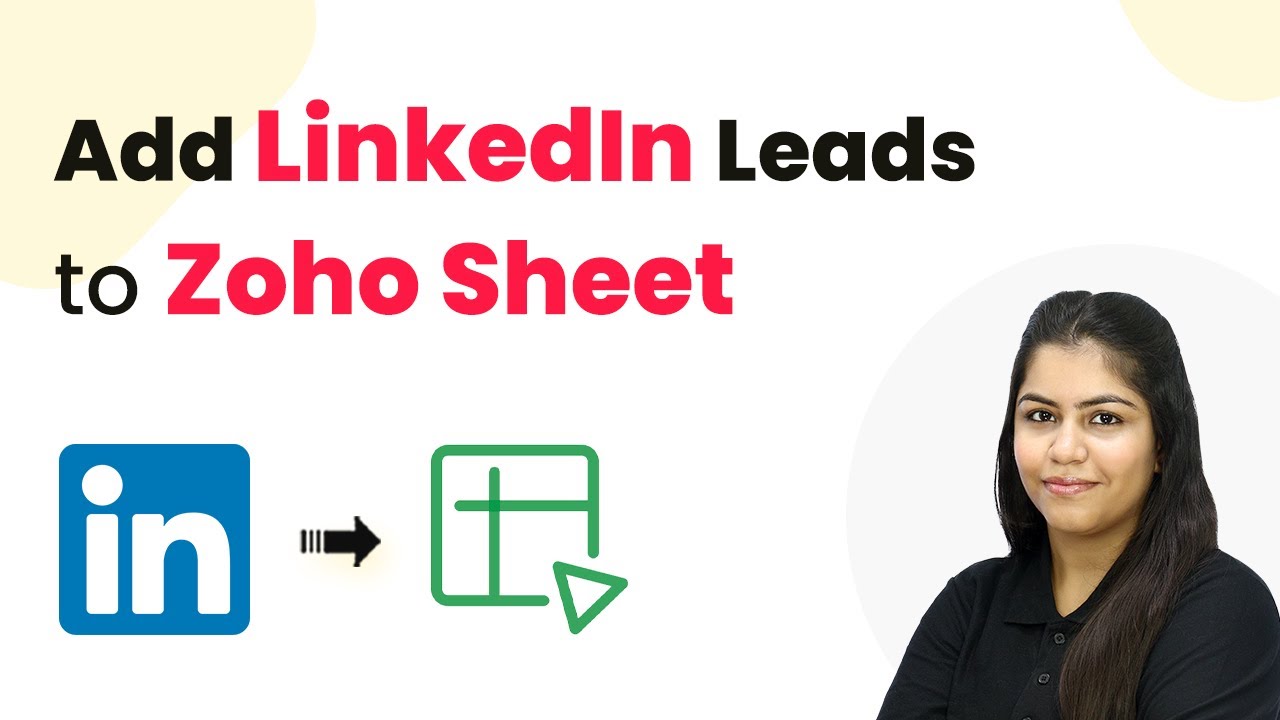
How to Add LinkedIn Leads to Zoho Sheets Automatically

Learn how to use Pabbly Connect to automatically add LinkedIn leads to Zoho Sheets without manual intervention. Step-by-step tutorial included. Build sophisticated automated workflows in less time than you think. This guide translates complex integrations into straightforward steps for immediate implementation.

Watch Step By Step Video Tutorial Below


1. Accessing Pabbly Connect for LinkedIn and Zoho Integration

To start adding LinkedIn leads to Zoho Sheets automatically, you first need to access Pabbly Connect. If you’re an existing user, simply log in to your account and open the workflow builder. New users can visit pabbl.com/connect to sign up for free, which grants you hundreds of tasks every month to explore the features of Pabbly Connect.

Once logged in, you will find the workflow builder, the core interface for automation. In this section, you will set up triggers and actions to automate the process of capturing LinkedIn leads and adding them to Zoho Sheets. This is essential for streamlining your lead management process.


2. Setting Up the Trigger for LinkedIn Leads

The next step involves setting up the trigger in Pabbly Connect. Click on the ‘Add Trigger’ button and search for LinkedIn. Select LinkedIn as your trigger application and choose the event as ‘Lead Notifications’. This step is crucial as it indicates that every time a lead is generated on LinkedIn, it will trigger the automation.

  • Search for LinkedIn in the trigger application.
  • Select ‘Lead Notifications’ as the event.
  • Click ‘Connect’ to establish a connection.

After selecting the event, if you have already connected LinkedIn with Pabbly Connect, you can select the existing connection. Otherwise, create a new connection by entering your LinkedIn account credentials. This connection is vital for pulling lead data into your automation workflow.


3. Capturing Lead Data from LinkedIn

Once the connection is established, you will be prompted to select your sponsored account. If no options are found, refresh the page to see your accounts. After selecting the account, click on ‘Save and Send Test Request’. This action will wait for a webhook response, which means Pabbly Connect is ready to receive lead data.

To test this, create a demo lead on LinkedIn by filling out the lead form associated with your ad. Although you might only be able to enter limited information (such as email and phone number) while in draft mode, this is sufficient for testing the automation. After submitting the lead form, Pabbly Connect will capture the webhook response.

  • Create a demo lead on LinkedIn.
  • Fill out the lead form and submit it.
  • Wait for Pabbly Connect to capture the lead details.

Once the lead data is captured, you will see all relevant details such as email, phone number, first name, last name, and company name displayed in Pabbly Connect. This confirms that the integration is functioning correctly.


4. Adding LinkedIn Lead Data to Zoho Sheets

With the lead data captured, the next step is to add this information to Zoho Sheets. In Pabbly Connect, click on ‘Add New Action Step’ and search for Zoho Sheets. Select it as your action application and choose ‘Create Row’ as the event. This sets up the action that will add the captured lead data to your specified Zoho Sheet.

Click ‘Connect’ to establish a connection with Zoho Sheets. If you do not have an existing connection, you will need to create one. This requires you to provide your Zoho domain, which can be found in the URL of your Zoho Sheets account. After entering the domain, grant the necessary permissions for Pabbly Connect to access your Zoho account.

Select ‘Create Row’ in Zoho Sheets. Enter your Zoho domain from the URL. Grant permissions to Pabbly Connect.

Once the connection is established, select the workbook and worksheet where you want to store the lead details. Use the mapping feature in Pabbly Connect to dynamically insert the lead data into the appropriate fields. This ensures that every new lead is automatically added to Zoho Sheets without manual input.


5. Finalizing the Automation Process

After mapping all lead details, click on ‘Save and Send Test Request’ to test the automation. If successful, you will receive a confirmation message indicating that the lead details have been added to your Zoho Sheet. This means that Pabbly Connect is successfully automating the process of adding leads from LinkedIn to Zoho Sheets.

From now on, every time a new lead is generated on LinkedIn, the details will automatically be added to your Zoho Sheets. This automation saves time and ensures that you never miss a lead. You can now focus on converting these leads into customers without worrying about manual data entry.

To summarize, using Pabbly Connect allows you to seamlessly integrate LinkedIn and Zoho Sheets, automating your lead management process effectively. This is a powerful tool that can enhance your business operations significantly.


Conclusion

In this tutorial, we explored how to use Pabbly Connect to automatically add LinkedIn leads to Zoho Sheets. By following the steps outlined, you can streamline your lead management process and improve efficiency in your business. Start automating today with Pabbly Connect for better productivity!

Ensure you check out Pabbly Connect to create business automation workflows and reduce manual tasks. Pabbly Connect currently offer integration with 2,000+ applications.

Get Instant Google Chat Alerts for New Google Ads Leads — Respond Faster & Close More!

Learn how to get instant Google Chat alerts for new Google Ads leads using Pabbly Connect. Follow our step-by-step tutorial to automate your lead notifications.

Watch Step By Step Video Tutorial Below


1. Access Pabbly Connect for Google Ads and Google Chat Integration

To get started with automating your Google Ads lead notifications, you need to access Pabbly Connect. Simply visit the Pabbly website and sign in to your account. If you are new, you can sign up for free to get started. This platform allows you to create workflows that integrate various applications seamlessly.

Once logged in, navigate to the Pabbly Connect dashboard. From here, you can create a new workflow. Click on the ‘Create Workflow’ button, and select the new beta workflow builder for a modern experience. Name your workflow as ‘Get Instant Google Chat Alerts for New Google Ads Leads’ and select an appropriate folder to save it.


2. Setting Up Google Ads as the Trigger in Pabbly Connect

In this step, you will set up Google Ads as the trigger application within the Pabbly Connect workflow. The trigger is the event that starts the automation process. Select Google Ads and choose the event as ‘New Lead Form Entry’ to capture new leads automatically.

  • Select ‘Google Ads’ as the trigger application.
  • Choose the trigger event: ‘New Lead Form Entry’.
  • Connect your Google Ads account by providing the required permissions.

After this, Pabbly Connect will provide you with a webhook URL. This URL acts as a bridge to connect Google Ads with Pabbly Connect. Copy this URL and paste it into your Google Ads lead form settings under the lead delivery option.


3. Sending Test Data from Google Ads to Pabbly Connect

Now that you have set up the trigger, it’s time to send test data to ensure the connection works correctly. In your Google Ads account, navigate to the lead form settings and paste the webhook URL you copied earlier. Click the option to send test data.

  • Open your Google Ads account and find your test campaign.
  • Paste the webhook URL in the lead delivery settings.
  • Click on ‘Send Test Data’ to verify the connection.

Once you send the test data, return to Pabbly Connect to check if the response has been captured successfully. If everything is set up correctly, you will see the test lead details reflected in your Pabbly Connect workflow.


4. Configuring Google Chat Hangout as the Action Step

After successfully capturing the test data, the next step is to configure Google Chat Hangout as the action application in Pabbly Connect. This is where you will send notifications about new leads. Select Google Chat Hangout and choose the action event as ‘Create Message’.

To set this up, you will need to enter the Google Chat webhook URL. In your Google Chat Hangout, create a new space and access the space settings to add a webhook. Copy the webhook URL and paste it into the required field in Pabbly Connect.

Now, you can customize the message that will be sent to your team. Use mapping to dynamically insert details from the Google Ads lead, ensuring that every new lead’s information is included in the notification sent to Google Chat.


5. Testing the Integration and Finalizing the Workflow

With Google Ads and Google Chat Hangout configured in Pabbly Connect, it’s time to test the entire workflow. Click on ‘Save and Send Test Request’ to send a message to your Google Chat space. If everything is set up correctly, you should see the notification appear in your chat.

This confirms that your automation is working. You will now receive alerts in Google Chat whenever a new lead comes in through Google Ads, allowing your team to respond faster and close more leads.

To summarize, you have set up an automated workflow using Pabbly Connect that connects Google Ads and Google Chat Hangout. This integration ensures that your team is notified instantly about new leads, enhancing your response time and improving your sales process.


Conclusion

In conclusion, using Pabbly Connect to integrate Google Ads with Google Chat Hangout allows for instant alerts on new leads. This automation helps teams respond faster and close more deals effectively.

Ensure you check out Pabbly Connect to create business automation workflows and reduce manual tasks. Pabbly Connect currently offer integration with 2,000+ applications.

How to Add Google Ads Leads to Omnisend Automatically

Learn how to automate the process of adding Google Ads leads to Omnisend using Pabbly Connect. Step-by-step guide with detailed instructions. Build sophisticated automated workflows in less time than you think. This guide translates complex integrations into straightforward steps for immediate implementation.

Watch Step By Step Video Tutorial Below


1. Accessing Pabbly Connect for Integration

To begin the process of adding Google Ads leads to Omnisend automatically, you need to access Pabbly Connect. If you are already a user, simply log in to your Pabbly Connect account and navigate to the workflow builder. For new users, visit the Pabbly Connect landing page by searching for ‘Pabbly.com/connect’ in your browser.

Once on the landing page, you will see the option to sign up for free in the top right corner. Click on this button to create your account. You will receive 100 free tasks every month, allowing you to explore the functionalities of Pabbly Connect and automate the addition of leads to Omnisend.


2. Setting Up the Trigger in Pabbly Connect

Now that you have accessed Pabbly Connect, the next step is to set up the trigger for your automation. Click on the ‘Add Trigger’ button within the workflow builder. In the search bar, type ‘Google Ads’ and select it as your trigger application.

  • Select the event as ‘New Lead Form Entry’.
  • Click the ‘Connect’ button to establish the connection.

Upon connecting, you will receive a webhook URL. Copy this URL as it will be used to link your Google Ads form to Pabbly Connect. This URL is crucial for capturing the lead details as they come in.


3. Linking Google Ads to Pabbly Connect

Next, navigate to your Google Ads account where you have the lead form set up. Find the form associated with your campaign and scroll to the ‘Lead Delivery’ section. Here, paste the webhook URL you copied from Pabbly Connect.

  • For the key field, enter the key as prompted.
  • Click on ‘Send Test Data’ to verify the connection.

After sending the test data, return to Pabbly Connect where it will indicate that it is waiting for a webhook response. You should see that the test lead details have been captured successfully, confirming that the connection is active.


4. Creating a Subscriber in Omnisend

Now that the Google Ads leads are being captured, the next step is to create a subscriber in Omnisend. Click on ‘Add New Action Step’ in your workflow and search for ‘Omnisend’ as the action application.

For the event, choose ‘Create Subscriber’ and click on ‘Connect’. If you have already connected Omnisend to Pabbly Connect, select the existing connection. If not, you will need to create a new connection by entering your Omnisend API key.

To obtain your API key, log in to your Omnisend account and navigate to the API key section. Click on ‘Create API Key’ and name it accordingly.

Once you have your API key, paste it into Pabbly Connect and click save to establish the connection.


5. Finalizing the Workflow in Pabbly Connect

With both Google Ads and Omnisend connected through Pabbly Connect, you can now finalize your workflow. You will need to map the lead details from Google Ads to the corresponding fields in Omnisend. Ensure to include the email, first name, and any other relevant information.

Once you have mapped all necessary fields, click on ‘Save and Send Test Request’ to verify that the subscriber is created successfully in Omnisend. You should receive a positive response indicating that the new subscriber has been added.

After confirming the setup, your automation is complete. From now on, every new lead generated from Google Ads will automatically create a subscriber in Omnisend without any manual intervention, thanks to Pabbly Connect.


Conclusion

In this tutorial, we explored how to use Pabbly Connect to automate the process of adding Google Ads leads to Omnisend. By following the steps outlined, you can efficiently manage your leads and enhance your marketing efforts without manual work. Embrace automation and optimize your lead management today!

Ensure you check out Pabbly Connect to create business automation workflows and reduce manual tasks. Pabbly Connect currently offer integration with 2,000+ applications.

Automate Your Bakery Orders Using WhatsApp Chatbot

Learn how to automate your bakery orders using WhatsApp Chatbot with Pabbly Chatflow. Follow this step-by-step tutorial for seamless integration. Implement professional chat automation that answers common questions, qualifies leads, and books appointments without human intervention.

Watch Step By Step Video Tutorial Below


1. Introduction to Pabbly Chatflow for Bakery Automation

In this section, we will explore how to use Pabbly Chatflow to automate your bakery orders using a WhatsApp chatbot. This powerful tool allows you to manage customer interactions efficiently, saving you time and effort.

To start, navigate to the Pabbly Chatflow website by entering ‘Pabbly.com/chatflow’ in your browser. Once there, you can sign up for a free account or log in if you’re already a user. Pabbly Chatflow provides you with 100 free credits every month to explore its features.


2. Setting Up Your WhatsApp Chatbot in Pabbly Chatflow

After logging into Pabbly Chatflow, you’ll land on the dashboard where you can manage your WhatsApp numbers. To create your chatbot, click on the ‘Flows’ option on the left sidebar, then select the ‘+ Add Flow’ button to begin.

  • Click on ‘+ Add Flow’
  • Name your flow (e.g., ‘Automate Your Bakery Orders’)
  • Select your trigger event (e.g., keywords like ‘hi’ or ‘hello’)

Once you’ve set the trigger, you can define the initial response message from the bot. This is where you will craft a welcoming message that greets customers and provides options like ‘View Menu’, ‘Place Order’, and ‘Contact Support’.


3. Creating Interactive Buttons for Customer Engagement

Next, you will enhance your Pabbly Chatflow setup by adding interactive buttons. After your welcome message, add three buttons: ‘View Menu’, ‘Place Order’, and ‘Contact Support’. This allows customers to easily navigate through their options.

For example, when a customer clicks ‘View Menu’, the bot should respond with an image of the menu. Use the ‘Media’ button to upload the menu image and add a caption. This visual engagement helps customers make informed choices.

  • Upload the menu image
  • Add a caption like ‘Our Menu’
  • Link the buttons to their respective actions

By structuring your chatbot this way, you ensure a smooth user experience that leads customers directly to their desired actions.


4. Collecting Customer Information with Pabbly Chatflow

As customers interact with your Pabbly Chatflow bot, it’s crucial to gather their information accurately. When a customer clicks ‘Place Order’, the bot should prompt them for their full name, item name, quantity, address, and contact number.

To implement this, use the ‘Ask a Question’ action for each piece of information you need. For instance, after asking for the full name, you can set up subsequent questions to gather the rest of the order details.

Ask for the full name Request the item name Inquire about the quantity and address

After collecting all necessary information, send a confirmation message summarizing the order details back to the customer, enhancing their experience.


5. Testing Your WhatsApp Chatbot in Pabbly Chatflow

To ensure your Pabbly Chatflow setup works correctly, it’s essential to conduct thorough testing. Send test messages like ‘hi’ or ‘hello’ to your WhatsApp business account and observe how the bot responds.

Monitor the interactions to confirm that the bot is sending the correct responses and handling customer queries effectively. This step is crucial to ensure that your bakery orders are automated as intended.

Once you are satisfied with the testing results, you can confidently launch your WhatsApp chatbot, knowing it will handle customer orders efficiently.


Conclusion

In summary, using Pabbly Chatflow to automate your bakery orders through a WhatsApp chatbot can streamline your business operations significantly. By following the steps outlined in this tutorial, you can create an efficient and engaging customer experience.

Ensure you check out Pabbly Connect to create business automation workflows and reduce manual tasks. Pabbly Connect currently offer integration with 2,000+ applications.

With Pabbly Chatflow, you can ensure that your customers receive prompt responses and can place orders seamlessly, enhancing your bakery’s overall service quality.

How to Auto-Send Emails for New Facebook Leads

Learn how to automate email sending for new Facebook leads using Pabbly Connect. Step-by-step tutorial with detailed instructions and examples. Develop expertise in application integration and learn how to design streamlined automation workflows using proven, simplified approaches.

Watch Step By Step Video Tutorial Below


1. Accessing Pabbly Connect for Integration

To start automating email sending for new Facebook leads, you need to access Pabbly Connect. If you are a new user, open a new tab and search for pabbl.com/connect. Once on the landing page, click on the ‘Sign up for free’ option in the top right corner. This will give you hundreds of tasks free every month to explore Pabbly Connect.

After signing up, log in to your Pabbly Connect account and open the workflow builder. This interface is crucial because it contains the trigger and action mechanisms that will drive your automation. The trigger indicates when an action should start, while the action specifies what should happen as a result.


2. Setting Up Facebook Lead Ads as Trigger

To set up Facebook Lead Ads as your trigger in Pabbly Connect, click on the ‘Add Trigger’ button. Search for ‘Facebook Lead Ads’ and select it. For the event, choose ‘New Lead Instant’ and click on ‘Connect’. If you have previously created a connection, select it; otherwise, click on ‘Add a new connection’.

  • Log into your Facebook account when prompted.
  • Select the Facebook page associated with your leads.
  • Choose the lead form you want to use for automation.

After setting up these options, enable the simple response button to capture responses more easily. Click on ‘Save and Send Test Request’ to initiate the connection. Pabbly Connect will wait for a webhook response, which you will capture in the next steps.


3. Capturing Webhook Response from Facebook

To capture the webhook response, open a new tab and search for the Meta for Developers page. Navigate to ‘Resources’ and then select ‘Developer Tools’. Here, find the ‘Lead Ads Rule Debug Tool’ to test your lead ads.

Make sure to select the same page and form you specified in Pabbly Connect. Fill in the test lead details in the form, such as:

After submitting the form, return to Pabbly Connect and check if the webhook response has been captured. You should see all the details you entered, confirming that Pabbly Connect has successfully received the lead information.


4. Sending Email via Gmail Action Step

Now that you have captured the lead details, it’s time to send an email using Gmail through Pabbly Connect. Click on ‘Add New Action Step’, search for Gmail, and select it. Choose ‘Send Email’ as the event and click on ‘Connect’.

If you have an existing connection, select it; otherwise, create a new one by signing into your Google account. After connecting, enter the sender’s name and email address. For the recipient’s email, map the email from the previous step to ensure personalized email delivery.

Subject: Welcome to Digital Dynamics Email Content: Personalize the message using the lead’s name.

Once all details are filled in, click on ‘Save and Send Test Request’. You will receive a confirmation that the email has been sent successfully. Check your Gmail to see the email received by the lead, confirming that Pabbly Connect has completed the automation workflow.


5. Testing the Automation with New Leads

To test the automation, delete the previous test lead and refresh the page. This step is crucial to ensure you can create a new lead. Fill in the form again with new details, such as:

First Name: Testing Last Name: User Email: [email protected]

Submit the lead form and check your Gmail inbox. Refresh the inbox to confirm that a new email has been sent to the lead with the personalized message. This demonstrates that Pabbly Connect is successfully automating the email sending process for new Facebook leads.


Conclusion

In this tutorial, we explored how to automate email sending for new Facebook leads using Pabbly Connect. By following the steps outlined, you can ensure timely communication with your leads, enhancing your business’s efficiency and responsiveness.

Ensure you check out Pabbly Connect to create business automation workflows and reduce manual tasks. Pabbly Connect currently offer integration with 2,000+ applications.

WhatsApp Bot That Sells Handmade Products 🧵

Learn how to create a WhatsApp bot that sells handmade products using Pabbly Chatflow with this detailed step-by-step tutorial. Explore how leading businesses automate customer interactions with carefully designed chat sequences that feel natural and helpful.

Watch Step By Step Video Tutorial Below


1. Accessing Pabbly Chatflow to Create Your WhatsApp Bot

To create a WhatsApp bot that sells handmade products, first, access Pabbly Chatflow by visiting the official website. If you’re a new user, click on the ‘Sign Up Free’ button to create an account and receive 100 free credits each month. Existing users can simply log in by clicking on the ‘Sign In’ button.

Once logged in, navigate to the dashboard of Pabbly Chatflow. Here, you’ll find various features. The first step is to add your WhatsApp number by clicking on the designated button on the right side. You can choose between the WhatsApp connect method or the manual method to integrate your WhatsApp account.


2. Creating Your WhatsApp Chatbot in Pabbly Chatflow

With your WhatsApp number added, it’s time to create your chatbot. Go to the ‘Flows’ section and click on the ‘Add Flow’ button. Name your chatbot appropriately, such as ‘WhatsApp Bot That Sells Handmade Products’. This name will help you identify the bot later. using Pabbly Connect

  • Click on the ‘Add Flow’ button.
  • Input a meaningful name for your chatbot.
  • Select the trigger event for your bot.

For the trigger event, select the ‘Keyword or Regex Match’ option. This allows the bot to respond when specific keywords are sent by users. Add keywords like ‘start’ or ‘hello’ to activate the bot.


3. Designing the Chatbot Flow with Pabbly Chatflow

After setting up the trigger, you can design the flow of your WhatsApp bot. Start by dragging the ‘Text’ button to create a welcome message that users will receive. Connect this to the trigger to ensure it follows the keyword input. using Pabbly Connect

Next, create buttons for user interaction. For example, add a button labeled ‘Browse Products’ and another labeled ‘Talk to Agent’. Each button can lead to different actions or responses from the bot. For the ‘Browse Products’ button, create a list of handmade products that users can select from.

  • Drag and drop the ‘Text’ button for welcome messages.
  • Add product sections with items and prices.
  • Create buttons for placing orders or going back to the list.

This structured approach ensures that users can easily browse and select products, enhancing their shopping experience through your WhatsApp bot.


4. Finalizing Your WhatsApp Bot Setup in Pabbly Chatflow

After designing your flow, it’s crucial to finalize the setup by adding necessary actions. For each product selected, ask the user for their preferred color and quantity. Use the ‘Ask Question’ feature to collect this information and store it using custom fields.

Once all details are collected, prompt users to share their shipping address and payment proof. This can be done by dragging in the respective buttons and connecting them to the flow. Ensure to set up a delay for payment verification before sending a final confirmation message.

By following these steps, you will have a fully functional WhatsApp bot that can efficiently handle sales for your handmade products, all facilitated by Pabbly Chatflow.


5. Testing Your WhatsApp Bot Created with Pabbly Chatflow

Once your WhatsApp bot setup is complete, it’s time to test its functionality. Open your WhatsApp and send the keyword ‘start’ to trigger the bot. You should receive a welcome message followed by options to browse products or talk to an agent.

Ensure that each button works as intended, leading to the appropriate responses and actions. If everything functions correctly, your WhatsApp bot is ready to sell handmade products effectively. Remember, Pabbly Chatflow is the backbone of this automation, enabling seamless interactions.


Conclusion

Creating a WhatsApp bot that sells handmade products is straightforward with Pabbly Chatflow. By following the steps outlined in this tutorial, you can automate your sales process efficiently. Enjoy the benefits of automation and enhance your business growth!

Ensure you check out Pabbly Connect to create business automation workflows and reduce manual tasks. Pabbly Connect currently offer integration with 2,000+ applications.

Creators! Auto-Sync Instagram Reels to YouTube Shorts!

Learn how to automatically sync Instagram Reels to YouTube Shorts using Pabbly Connect. Follow this detailed tutorial for seamless integration. Develop expertise in application integration and learn how to design streamlined automation workflows using proven, simplified approaches.

Watch Step By Step Video Tutorial Below


1. Access Pabbly Connect for Automation

To begin syncing your Instagram Reels to YouTube Shorts, first, you need to access Pabbly Connect. Go to the Pabbly Connect website and either sign in or create a new account. This platform is essential for automating the integration process between Instagram and YouTube.

Once logged in, navigate to the Pabbly Connect dashboard. Here, you will see options to create a new workflow. Follow these steps to get started:

  • Click on ‘Create Workflow’ to initiate a new automation.
  • Select the ‘New Beta Method’ for a modern approach.

This is where you will set up the automation to link your Instagram account with your YouTube channel via Pabbly Connect.


2. Create Your Workflow in Pabbly Connect

In this section, you will create the workflow that connects Instagram and YouTube. After clicking on ‘Create Workflow’, give your workflow a name, such as ‘Auto Upload Instagram Reels to YouTube’. This helps in identifying your workflow later.

Next, choose the trigger application. Here’s how to set it up:

  • Select ‘Instagram for Business’ as the trigger application.
  • Choose the trigger event as ‘New Media Posted’.

This setup ensures that every time a new reel is posted on Instagram, Pabbly Connect captures that event and initiates the next steps in the workflow.


3. Connect Your Instagram Account to Pabbly Connect

To allow Pabbly Connect to access your Instagram account, you need to connect it properly. Click on the connect button and choose your Instagram account. Follow the prompts to authorize the connection, ensuring that you grant the necessary permissions.

After connecting, you will select the specific Instagram account from which you want to pull the Reels. Once selected, click on ‘Save and Send Test Request’ to confirm that the connection is successful. You should see a response indicating the last media posted on your Instagram account.


4. Upload Reels to YouTube Shorts via Pabbly Connect

Now that your Instagram account is connected, it’s time to set up the action to upload the Reels to YouTube. Select ‘YouTube’ as the action application. The event will be to ‘Upload Video’. This is where Pabbly Connect will facilitate the transfer of content from Instagram to YouTube.

Next, you need to map the data. For the video title, use the caption from your Instagram post. Make sure to also include the video URL and any other relevant details. This ensures that your YouTube Shorts are properly titled and described based on your Instagram content.

Map the video title to the caption from Instagram. Set the video description to provide context for viewers.

By doing this, Pabbly Connect ensures that your YouTube Shorts are engaging and informative, directly reflecting your Instagram content.


5. Test Your Integration and Activate

After setting up the action step, it’s crucial to test your integration. Click on ‘Save and Send Test Request’ to verify that everything works as expected. You should see a confirmation that your YouTube channel has successfully received the new video.

Once confirmed, activate your workflow. This means every time you post a new Reel on Instagram, it will automatically upload to your YouTube channel as a Short. This automation saves you time and ensures consistent content across platforms.

With Pabbly Connect, you can streamline your content creation process, allowing you to focus more on creating rather than posting.


Conclusion

In conclusion, using Pabbly Connect to auto-sync your Instagram Reels to YouTube Shorts is a game changer for content creators. This tutorial has outlined the exact steps to set up this integration seamlessly. By automating this process, you can enhance your content distribution and save valuable time.

Ensure you check out Pabbly Connect to create business automation workflows and reduce manual tasks. Pabbly Connect currently offer integration with 2,000+ applications.

How to Add Meta Ads Details to Google Sheets Automatically

Learn how to seamlessly integrate Meta Ads with Google Sheets using Pabbly Connect to automate lead details collection effortlessly. Implement the precise methodologies leading organizations use to automate repetitive tasks, illustrated with practical examples designed for immediate application.

Watch Step By Step Video Tutorial Below


1. Accessing Pabbly Connect for Meta Ads Integration

To add Meta Ads details into Google Sheets automatically, you will first need to access Pabbly Connect. This platform allows seamless integration between various applications, including Google Sheets and Meta Ads.

If you are a new user, open a new tab and search for ‘Pabbly.com/connect’. Click on the ‘Sign Up for Free’ option in the top right corner to create your account. Existing users can log in directly to their Pabbly Connect dashboard and access the workflow builder.


2. Creating a Workflow in Pabbly Connect

Now that you have logged into Pabbly Connect, it’s time to create a new workflow. Click on the ‘Add Trigger’ button to set up your automation. You will need to choose the application from which you want to collect lead details.

  • Select ‘Facebook Lead Ads’ or ‘Instagram Lead Ads’ based on your needs.
  • Choose the event as ‘New Lead Instant’.
  • Connect your Facebook account if prompted.

Once connected, select the page name and lead generation form you wish to use. This setup is crucial as it initiates the automation process whenever a new lead is received.


3. Capturing Lead Details from Meta Ads

After setting up the trigger in Pabbly Connect, you will need to capture the lead details. Click on the ‘Save and Send Test Request’ button. This action will wait for a webhook response from Meta Ads.

Open a new tab and navigate to the Meta for Developers page. Use the Lead Ads Debug Tool to select the same page and form you previously set up. Fill out the lead form and submit it. This action will generate a test lead that Pabbly Connect will capture.


4. Adding Leads to Google Sheets Automatically

With the lead details captured, the next step is to send this information to Google Sheets using Pabbly Connect. Click on ‘Add New Action Step’ and select ‘Google Sheets’ as your action application.

  • Choose the event as ‘Add New Row’.
  • Connect your Google account and allow permissions.
  • Map the lead details from the previous step to the corresponding columns in your Google Sheet.

Click on ‘Save and Send Test Request’ to verify that the details are correctly added to your Google Sheet. This automation will run in real-time, ensuring that every new lead is documented automatically.


5. Testing the Automation for Efficiency

To ensure that your automation works as intended, delete the previous lead from Google Sheets. This allows you to test the automation with a fresh lead. Fill out the lead form again and submit it.

Within seconds, check your Google Sheets to confirm that the new lead details have been added. This demonstrates how efficiently Pabbly Connect integrates Meta Ads with Google Sheets, making lead management seamless.


Conclusion

Using Pabbly Connect, you can automate the addition of Meta Ads details into Google Sheets effortlessly. This integration allows you to manage leads more efficiently, saving time and reducing manual errors. Start utilizing this powerful automation tool today!

Ensure you check out Pabbly Connect to create business automation workflows and reduce manual tasks. Pabbly Connect currently offer integration with 2,000+ applications.

Save Moxie Support Tickets to Google Sheets Automatically

Learn how to automate saving Moxie support tickets to Google Sheets using Pabbly Connect. Follow our step-by-step tutorial for seamless integration. This comprehensive guide reveals exactly how to connect your applications and automate repetitive tasks — accessible for professionals of all technical backgrounds.

Watch Step By Step Video Tutorial Below


1. Accessing Pabbly Connect for Automation

To automate saving Moxie support tickets to Google Sheets, start by accessing Pabbly Connect. This platform simplifies the integration process without requiring coding skills. Open a new tab and navigate to the Pabbly Connect website.

Once on the landing page, you have the option to sign in or sign up for a free account. If you are a new user, click on the ‘Sign up for free’ button to get started with 100 free tasks monthly. Existing users can simply log in to their Pabbly Connect account.


2. Creating a New Workflow in Pabbly Connect

After logging into Pabbly Connect, you will see the dashboard. To create a new workflow, click on the ‘Create Workflow’ button. You can choose to use the beta method for a more modern experience or the classic version for familiarity.

  • Select the beta method for a modern workflow experience.
  • Name your workflow ‘Save Moxie Support Tickets to Google Sheets Automatically’.
  • Choose a folder for your workflow or create a new one.

Click the ‘Create’ button, and your workflow will be established. In Pabbly Connect, each workflow consists of a trigger and an action. The trigger captures the event, while the action performs the subsequent steps.


3. Setting Up the Trigger for Moxie

To start, set up the trigger in your Pabbly Connect workflow. Select ‘Moxie’ as the trigger application. The event you want to capture is ‘Ticket Created’. After selecting this, click on the ‘Connect’ button to generate a webhook URL.

Copy this webhook URL and navigate to your Moxie account. Go to the workspace settings, find the integration section, and add a REST hook. Paste the copied webhook URL there and save the settings. This establishes the connection between Moxie and Pabbly Connect.


4. Testing the Connection Between Moxie and Pabbly Connect

Now that the connection is established, it’s time to test it. Create a new ticket in your Moxie account by clicking on the ‘Add Ticket’ button. Fill in the subject and description, then click on the ‘Create’ button.

After a few seconds, return to your Pabbly Connect workflow to see if the trigger captured the new ticket details. You should see the ticket’s subject, description, and other relevant information displayed in the trigger response section.


5. Adding Ticket Details to Google Sheets

With the Moxie trigger successfully capturing new tickets, the next step is to add this data to Google Sheets. In your Pabbly Connect workflow, add an action step and choose ‘Google Sheets’ as the application. The event should be ‘Add New Row’. Click on the ‘Connect’ button to link your Google Sheets account.

  • Select the spreadsheet named ‘Moxy Support Tickets’.
  • Choose the sheet named ‘Sheet1’.
  • Map the fields for ticket ID, subject, description, status, and other relevant details from the trigger.

Once all fields are mapped correctly, click on the ‘Save and Send Test Request’ button. You should see the ticket details appear in your Google Sheets, confirming that the integration is working smoothly. This is how Pabbly Connect facilitates the automation of saving Moxie support tickets to Google Sheets.


Conclusion

In this tutorial, we demonstrated how to automate saving Moxie support tickets to Google Sheets using Pabbly Connect. This integration saves time and reduces manual data entry, ensuring all ticket details are recorded accurately and efficiently. By following these steps, you can streamline your workflow and enhance productivity.

Ensure you check out Pabbly Connect to create business automation workflows and reduce manual tasks. Pabbly Connect currently offer integration with 2,000+ applications.

Notify Your Team on Discord for Razorpay Payments Using Pabbly

Learn how to integrate Razorpay with Discord using Pabbly Connect to notify your team about payments. Step-by-step tutorial included. Follow this definitive guide to creating powerful automated workflows with straightforward, efficiency-focused solutions that save valuable time.

Watch Step By Step Video Tutorial Below


1. Accessing Pabbly Connect for Razorpay and Discord Integration

To notify your team on Discord about Razorpay payments, start by accessing Pabbly Connect. If you are a new user, open a new tab and visit Pabbly.com/connect to reach the Pabbly Connect landing page. Here, you will see options to sign in or sign up for free.

Click on the ‘Sign up for free’ button to create your account. Once registered, log into Pabbly Connect and navigate to the workflow builder. This is where you’ll set up the automation process to connect Razorpay and Discord.


2. Setting Up the Trigger with Razorpay in Pabbly Connect

In the workflow builder of Pabbly Connect, the first step is to add a trigger. Click on the ‘Add Trigger’ button and search for Razorpay. Select Razorpay and choose the event as ‘Payment Captured’. This event will initiate the workflow whenever a payment is made.

  • Select ‘Payment Captured’ as the event.
  • Click on ‘Connect’ to generate a webhook URL.
  • Copy the generated webhook URL for use in Razorpay.

After copying the webhook URL, open your Razorpay dashboard. Navigate to the ‘Developers’ section on the left side, then select ‘Webhooks’. Click on ‘Add New Webhook’ and paste the URL you copied from Pabbly Connect. Make sure to select ‘Payment Captured’ as the active event before saving the webhook.


3. Testing the Webhook in Razorpay

Once the webhook is set up in Razorpay, it’s time to test it. Go back to your Razorpay dashboard and navigate to the payment pages. Open a payment page and conduct a test transaction to ensure that the webhook is functioning correctly.

  • Copy the payment page URL and open it in a new tab.
  • Fill in the required details and select UPI as the payment method.
  • Complete the payment to generate a webhook response.

After completing the payment, return to Pabbly Connect. You should see that the webhook response has been successfully captured, indicating that your Razorpay setup is working correctly.


4. Setting Up the Action to Notify Discord

Now that the trigger is working, the next step is to notify your team on Discord. In the Pabbly Connect workflow, click on ‘Add New Action Step’ and search for Discord. Select it and choose the event as ‘Send Channel Message’.

Click on ‘Connect’ to establish the connection with your Discord server. You will need to provide a webhook URL from Discord. To get this, go to your Discord server, access the server settings, and navigate to ‘Integrations’ and then ‘Webhooks’. Click on ‘New Webhook’ to create a webhook for your channel.


5. Finalizing the Discord Notification Message

After creating the webhook in Discord, copy the URL and paste it into Pabbly Connect. You can customize the message to be sent to the Discord channel. For instance, include details like customer name, email, and order ID in the message template.

To ensure the message is dynamic, use the mapping feature in Pabbly Connect. This will allow the message to automatically update with details from each new payment. Once you have set up the message, click on ‘Save and Send Test Request’ to verify that the message is sent successfully to your Discord channel.

After testing, you can check your Discord channel to see if the notification was received. This confirms that your integration is complete, and your team will now be notified of any new payments received through Razorpay in real-time.


Conclusion

In this tutorial, we demonstrated how to use Pabbly Connect to integrate Razorpay with Discord, allowing your team to receive notifications for new payments. This automation enhances communication and keeps your team informed about transactions efficiently.

Ensure you check out Pabbly Connect to create business automation workflows and reduce manual tasks. Pabbly Connect currently offer integration with 2,000+ applications.