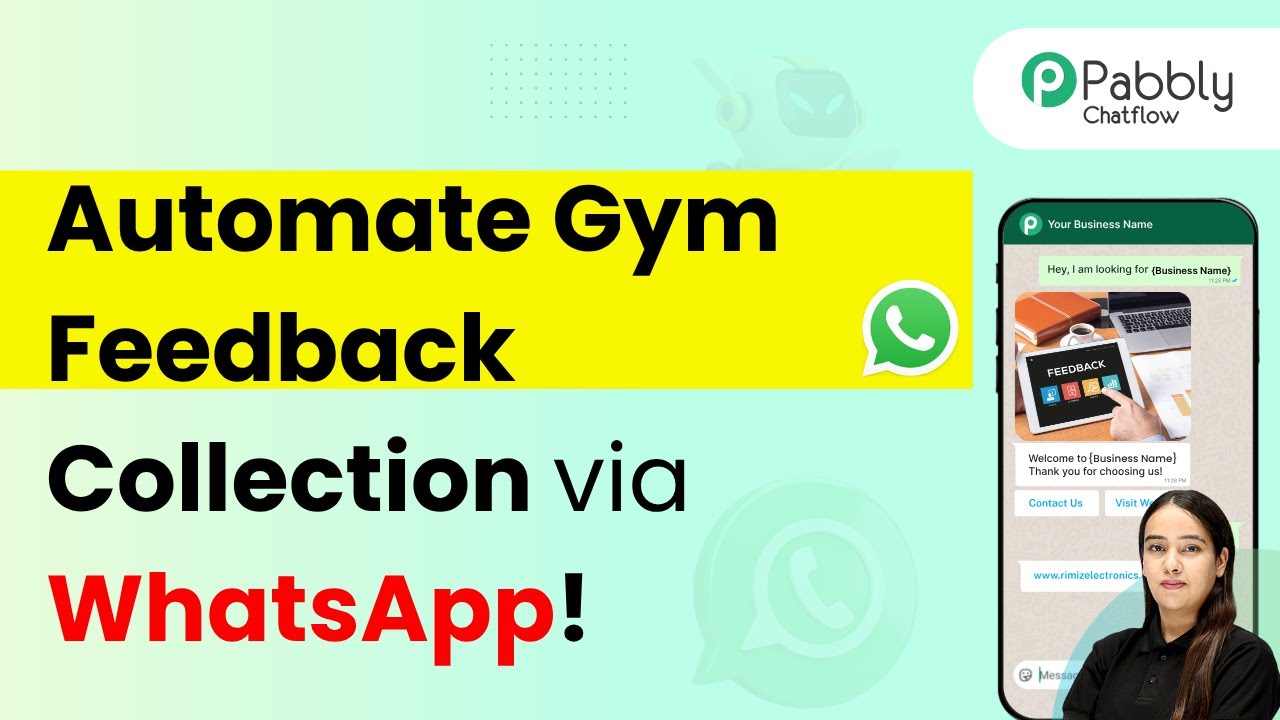
Automate Customer Feedback Collection for Gyms on WhatsApp Using Pabbly Chatflow

Learn how to automate customer feedback collection for gyms on WhatsApp using Pabbly Chatflow and Pabbly Chatflow. Follow this step-by-step tutorial. Master conversational marketing with practical techniques for creating chatbots that engage visitors at exactly the right moment in their journey.

Watch Step By Step Video Tutorial Below


1. Accessing Pabbly Chatflow for Feedback Automation

To automate customer feedback collection for your gym using Pabbly Chatflow, you first need to access the platform. Navigate to the Pabbly website and sign in or create an account if you’re a new user. Once logged in, you will be directed to the Pabbly dashboard where various applications, including Pabbly Chatflow, are available.

After accessing Pabbly Chatflow, you can start creating a feedback collection flow. This process is straightforward and user-friendly, allowing gym owners to efficiently gather customer insights. Click on the ‘Access Now’ button under Pabbly Chatflow to enter the dashboard, where you can manage your WhatsApp numbers and set up your feedback collection chatbot.


2. Creating a Chatflow for Customer Feedback

In this section, we will create a chatflow specifically for collecting feedback from gym customers using Pabbly Chatflow. Start by clicking on the ‘Add Chat Flow’ button located at the top right corner of the dashboard. You will then be prompted to name your chat flow; a suitable name could be ‘Feedback Collection for Gym on WhatsApp’.

  • Click on the ‘Add Chat Flow’ button.
  • Name your chat flow appropriately.
  • Select the trigger events for initiating the chat.

Once named, proceed to configure the triggers. You can set up keywords or specific events that will initiate the chatbot interaction. This allows customers to easily start providing feedback by simply messaging your gym via WhatsApp.


3. Sending Feedback Requests via WhatsApp

After setting up the chatflow in Pabbly Chatflow, the next step is to send feedback requests to your customers. This is done through the ‘Dialog’ option where you can create a template message. The message should express gratitude for the customer’s visit and request feedback on their experience.

For example, you could use a template like: ‘Hi [Customer Name], thank you for visiting our gym today! We would love to hear how your session went. Please rate your experience: Excellent, Good, or Needs Improvement.’ This message can be sent instantly to your customers, making the feedback process seamless.


4. Collecting and Processing Customer Feedback

Once your customers respond to the feedback request, Pabbly Chatflow will automatically collect and categorize their responses. Depending on the feedback option selected, the chatbot will send tailored follow-up messages thanking them for their input and encouraging further engagement.

For instance, if a customer selects ‘Good,’ the bot could respond with, ‘Thank you for your feedback! We will work to make your next visit even better.’ This personalized approach enhances customer satisfaction and encourages them to return.

  • Automatically categorize responses based on customer feedback.
  • Send personalized follow-up messages based on feedback.
  • Encourage customers to provide additional feedback or suggestions.

By utilizing Pabbly Chatflow, gym owners can efficiently manage and analyze customer feedback, allowing for continuous improvement in service delivery.


5. Finalizing and Activating Your Chatbot

After configuring the chatflow and ensuring all feedback options are set, it’s crucial to finalize and activate your chatbot within Pabbly Chatflow. Ensure all settings are correctly adjusted and save your flow. Activation allows the chatbot to begin functioning in real-time, collecting feedback from your gym customers.

To activate, simply click on the ‘Save’ button and confirm that your flow is updated successfully. Once activated, your feedback collection process will run smoothly, engaging customers and gathering valuable insights automatically.

Remember, the success of your feedback collection lies in the effectiveness of your chatbot. Regularly review the collected data to improve your services and enhance customer satisfaction.


Conclusion

In conclusion, automating customer feedback collection for gyms on WhatsApp using Pabbly Chatflow is a streamlined process that enhances customer engagement and satisfaction. By following the steps outlined, gym owners can effectively gather insights and improve their services.

Ensure you check out Pabbly Connect to create business automation workflows and reduce manual tasks. Pabbly Connect currently offer integration with 2,000+ applications.

Automate Invoicing: A Step-by-Step Guide Using Pabbly Connect

Learn how to automate invoice sending from Google Sheets to clients using Pabbly Connect. Follow this detailed tutorial for step-by-step instructions. Explore systematic approaches to creating efficient automation solutions that convert technical concepts into practical, implementable instructions.

Watch Step By Step Video Tutorial Below


1. Accessing Pabbly Connect for Automation

To create and send automated invoices from Google Sheets to clients, you need to access Pabbly Connect. This powerful integration platform allows you to connect various applications seamlessly. Start by visiting the Pabbly Connect website at www.Pabbly.com/connect.

Once there, you will see options to either sign in or sign up for a free account. If you are a new user, click on ‘Sign Up Free’ to create an account. If you already have an account, simply sign in. After logging in, you will be taken to the dashboard where you can create workflows using Pabbly Connect.


2. Creating Your First Workflow with Pabbly Connect

Once you are logged into Pabbly Connect, click on the ‘Create Workflow’ button to start building your automation. You will be prompted to select a workflow builder. Choose the new workflow builder for a modern and flexible experience.

  • Click on ‘Create Workflow’ to initiate.
  • Enter a name for your workflow, such as ‘Invoice Gmail from Google Sheet’.
  • Select the folder for your workflow if desired.

After naming your workflow and selecting a folder, click the ‘Create’ button. You will receive a confirmation that your workflow has been created successfully. Now, you need to set up the trigger for your workflow.


3. Setting Up the Trigger in Pabbly Connect

In this section, you will set up the trigger for your workflow using Pabbly Connect. The trigger app will be Google Sheets, as you want the automation to start whenever a new invoice is added. Click on the ‘Add Trigger’ button and select Google Sheets.

Next, you will choose the event that will trigger the workflow. Select the option for when a new row is added to your Google Sheet. After this, you will connect Pabbly Connect to your Google Sheets account by clicking the ‘Connect’ button.

  • Copy the webhook URL provided by Pabbly Connect.
  • Open your Google Sheet and go to Extensions > Add-ons > Get Add-ons.
  • Search for ‘Pabbly Connect Webhooks’ and install it.

After installation, you will set up the webhook URL in the Pabbly Connect Webhooks add-on. This will allow your Google Sheet to send data to Pabbly Connect whenever a new entry is made.


4. Configuring the Action to Send Emails

Now that your trigger is set up, it’s time to configure the action that will send the emails. For this, select Gmail as your action app within Pabbly Connect. Click on ‘Add New Action’ and choose the ‘Send Email’ event.

You will need to connect your Gmail account to Pabbly Connect. If you already have a connection, you can select it; otherwise, click on ‘Add New Connection’ and authenticate your Gmail account.

Map the recipient’s email address from the Google Sheet data. Fill in the email subject and body using mapped fields from the invoice data. Review all mapped fields to ensure they contain the correct data.

Once you have filled in all the necessary fields, click the ‘Save and Send Test Request’ button to check if the email is sent successfully. If everything is set up correctly, you will receive the invoice email in your Gmail account.


5. Testing and Activating the Workflow

With your action configured, it’s time to test your workflow in Pabbly Connect. Make a test entry in your Google Sheet with the necessary details like client name, email, invoice number, amount, and due date. After adding the test entry, go back to Pabbly Connect.

Click on the ‘Send Test’ button in the initial setup to simulate the process. If the test is successful, you will see a confirmation message indicating that the data has been sent successfully. Check your Gmail account to confirm receipt of the invoice email.

Once you confirm that the workflow is functioning as intended, you can activate it. This will allow Pabbly Connect to automate the invoicing process every time a new entry is made in your Google Sheets. This automation will save you time and ensure that your clients receive their invoices promptly.


Conclusion

In this tutorial, you learned how to automate the process of sending invoices from Google Sheets to clients using Pabbly Connect. By following these steps, you can streamline your invoicing process and enhance your business operations.

Ensure you check out Pabbly Connect to create business automation workflows and reduce manual tasks. Pabbly Connect currently offer integration with 2,000+ applications.

With Pabbly Connect, you can create more automations to simplify various aspects of your workflow, making your tasks more efficient and effective.

How to Send AI-Powered Follow-Up Emails After Product Purchase via Stripe using Pabbly Connect

Learn to automate AI-powered follow-up emails after product purchases via Stripe using Pabbly Connect. Step-by-step tutorial to streamline your email process. Explore systematic approaches to creating efficient automation solutions that convert technical concepts into practical, implementable instructions.

Watch Step By Step Video Tutorial Below


1. Accessing Pabbly Connect for Automation

To send AI-powered follow-up emails after a product purchase via Stripe, you first need to access Pabbly Connect. Start by visiting the Pabbly Connect website and signing in with your credentials. If you are a new user, you can sign up for free. This platform will facilitate the integration between Stripe and your email service.

Once logged in, you can create a new workflow. Click on the ‘Create Workflow’ button and select the classic version for a familiar interface. Name your workflow appropriately, such as ‘Send AI-Powered Follow-Up Emails After Product Purchase via Stripe.’ This sets the stage for automating your email follow-ups.


2. Setting Up Stripe Integration in Pabbly Connect

In this section, you will set up the Stripe integration using Pabbly Connect. Choose Stripe as your trigger application and select the trigger event as ‘Checkout Session Completed’. This event will initiate the workflow whenever a product is purchased. Pabbly Connect will provide a webhook URL that you need to configure in your Stripe account.

  • Sign in to your Stripe account and go to the Developers page.
  • Click on ‘Webhooks’ and then select ‘Add Endpoint’.
  • Paste the webhook URL from Pabbly Connect and select ‘Checkout Session Completed’ as the event.

After setting up the webhook, return to Pabbly Connect and refresh the fields to capture the data from the Stripe transaction. You will then test the integration by completing a payment on Stripe to ensure everything is working correctly.


3. Integrating OpenAI for Email Content Generation

Now, it’s time to integrate OpenAI within Pabbly Connect to generate the email content automatically. After the Stripe integration, add OpenAI as the action application. Choose ‘ChatGPT’ as the action event. You will need to connect your OpenAI account by providing the API key, which can be generated from your OpenAI account settings.

Once connected, you will set up the prompt for the AI to generate the email content. This prompt should include specific details like the customer’s name and the product purchased. Use the data mapped from Stripe to ensure that the emails are personalized. For example, use the customer’s name from the Stripe response to make the email more engaging.


4. Sending Emails via Gmail with Pabbly Connect

The final step involves integrating Gmail to send the generated emails. In Pabbly Connect, add Gmail as the action application and select ‘Send Email’ as the action event. You will need to connect your Gmail account by authorizing Pabbly Connect to send emails on your behalf.

  • Map the recipient email field with the customer’s email from Stripe.
  • Set the email subject dynamically, such as ‘Thank You for Your Purchase, [Customer Name]’.
  • Include the email content generated by OpenAI in the email body.

After mapping all necessary fields, click on ‘Save and Send Test’ to verify that the email is sent successfully. Check your Gmail account to confirm that the email has been received.


5. Conclusion

Using Pabbly Connect, you can effectively automate the process of sending AI-powered follow-up emails after a product purchase via Stripe. This integration not only saves time but also enhances customer engagement through personalized communication. By following the steps outlined in this tutorial, you can streamline your email follow-up process seamlessly.

Ensure you check out Pabbly Connect to create business automation workflows and reduce manual tasks. Pabbly Connect currently offer integration with 2,000+ applications.

Check out Pabbly Connect – Automate your business workflows effortlessly! Sign Up Free – Start your journey with ease! 10,000+ Video Tutorials – Learn step by step! Join Pabbly Facebook Group – Connect with 21,000+ like minded people!
How to Capture Leads from Facebook Lead Ads into Google Sheets Automatically Using Pabbly Connect

Learn how to automate the process of capturing leads from Facebook Lead Ads into Google Sheets using Pabbly Connect. Follow this detailed tutorial for step-by-step instructions.

Watch Step By Step Video Tutorial Below


1. Accessing Pabbly Connect for Automation

To capture leads from Facebook Lead Ads into Google Sheets automatically, you need to access Pabbly Connect. This platform allows seamless integration between various applications, including Facebook and Google Sheets.

Start by visiting the Pabbly Connect website at www.Pabbly.com/connect. If you are a new user, click on the ‘Sign Up Free’ button. Existing users can simply sign in. Once logged in, you will be directed to the dashboard where you can create workflows.


2. Creating a Workflow in Pabbly Connect

Once you are on the Pabbly Connect dashboard, you can create a new workflow to connect Facebook Lead Ads with Google Sheets. Click on the ‘Create Workflow’ button to begin.

  • Select the New Workflow Builder for a modern interface.
  • Name your workflow, such as ‘Capture Facebook Lead Ads to Google Sheets’.
  • Click on the Create button to finalize your workflow setup.

After creating the workflow, you will need to set the trigger app to Facebook Lead Ads. This app will initiate the workflow whenever a new lead is captured.


3. Setting Up Facebook Lead Ads as Trigger App

In this step, you will configure Facebook Lead Ads as your trigger app in Pabbly Connect. Click on the ‘Add Trigger’ option and select Facebook Lead Ads from the list.

Choose the event ‘New Lead Instant’ to trigger the workflow whenever a new lead is generated. Click on the ‘Connect’ button to establish a connection with your Facebook account. You will need to authorize Pabbly Connect to access your Facebook Lead Ads.


4. Creating Google Sheet for Capturing Leads

Now, it’s time to set up Google Sheets as the action app in your Pabbly Connect workflow. Click on ‘Add Action’ and select Google Sheets from the action app options.

Choose the action event ‘Add New Row’ to automatically add leads to your Google Sheet. Connect your Google account to Pabbly Connect and select the spreadsheet you want to use. Ensure that your Google Sheet is set up with appropriate columns for First Name, Last Name, Email, and Phone Number.

  • Map the fields from Facebook Lead Ads to the corresponding columns in Google Sheets.
  • Select ‘Save and Send Test Request’ to verify the connection.

After completing these steps, your leads from Facebook will automatically populate the Google Sheet.


5. Testing the Integration

To ensure everything is working smoothly, you should test the integration you built with Pabbly Connect. Fill out the Facebook Lead Ads form with test data and submit it.

After submitting the form, check your Google Sheet to confirm that the new lead appears correctly. This will verify that your automation is functioning as intended, capturing leads from Facebook and adding them to Google Sheets automatically.

With Pabbly Connect, you can streamline your lead capturing process, making it more efficient for your online business.


Conclusion

In this tutorial, we explored how to capture leads from Facebook Lead Ads into Google Sheets automatically using Pabbly Connect. By following these steps, you can enhance your lead management process and ensure that no lead is missed.

Ensure you check out Pabbly Connect to create business automation workflows and reduce manual tasks. Pabbly Connect currently offer integration with 2,000+ applications.

Automate Staff Scheduling for Restaurants via WhatsApp with Pabbly Chatflow

Learn how to automate staff scheduling for restaurants using Pabbly Chatflow and WhatsApp. Step-by-step guide for seamless integration and efficient management. Discover practical methods for designing chat sequences that capture leads, answer questions, and guide users to the next step in your funnel.

Watch Step By Step Video Tutorial Below


1. Setting Up Pabbly Chatflow for Staff Scheduling

Pabbly Chatflow is a powerful tool that allows restaurant owners to automate staff scheduling via WhatsApp. To get started, visit the Pabbly website and sign in to your account. If you are a new user, you can create a free account to access the features. using Pabbly Connect

Once logged in, navigate to the Pabbly Chatflow dashboard. Here, you can manage all your WhatsApp numbers and set up your chatbot for staff scheduling. Click on the ‘Add WhatsApp Number’ button located at the top right corner to begin integrating your WhatsApp account.


2. Creating Your AI Assistant in Pabbly Chatflow

With Pabbly Chatflow, creating an AI assistant to handle staff scheduling inquiries is straightforward. Click on the ‘AI Assistant’ button on your dashboard. This feature allows you to build a customized chatbot tailored for your restaurant’s needs. using Pabbly Connect

  • Select the AI instruction type, such as an AI agent or customer support agent.
  • Set the AI configuration, including temperature and model type.
  • Upload your knowledge base, which will guide the AI responses.

After setting up these parameters, your AI assistant will be ready to manage staff scheduling tasks effectively. Ensure that you save your changes to activate the assistant.


3. Integrating Google Docs for Knowledge Base

Pabbly Chatflow allows you to upload a knowledge base directly from Google Docs, which is essential for your AI assistant to answer staff queries accurately. Create a Google Document containing all relevant information about your restaurant’s scheduling policies, shift timings, and FAQs. using Pabbly Connect

Once your document is ready, return to Pabbly Chatflow and navigate to the AI Assistant settings. Here, you can upload the Google Document as your knowledge base. This integration ensures that your AI assistant has all the necessary information to assist staff members efficiently.


4. Customizing the Assistant Interface

To enhance user experience, Pabbly Chatflow allows you to customize the assistant interface. This includes setting a header name, initial messages, and footer text. Personalizing these elements can help create a welcoming atmosphere for your staff. using Pabbly Connect

  • Set a header name that reflects your restaurant’s brand.
  • Create an initial message that introduces the assistant’s capabilities.
  • Add footer text with contact information or links to your restaurant’s website.

After customizing the interface, save your settings to ensure that staff members receive a consistent and professional experience when interacting with the AI assistant.


5. Testing Your AI Assistant’s Functionality

Once your AI assistant is fully set up, it’s crucial to test its functionality to ensure it meets your restaurant’s needs. Open WhatsApp and type a key phrase, such as ‘I need help’. The assistant should respond promptly with a message offering assistance. using Pabbly Connect

During testing, verify that the assistant can handle various queries related to staff scheduling, including shift confirmations and changes. Make sure it responds accurately based on the knowledge base you uploaded earlier. If adjustments are needed, return to Pabbly Chatflow to refine the AI settings.


Conclusion

In conclusion, automating staff scheduling for restaurants via WhatsApp using Pabbly Chatflow simplifies the process significantly. By following the steps outlined, you can create an efficient AI assistant that handles staff inquiries effectively, ensuring smooth operations in your restaurant.

Ensure you check out Pabbly Connect to create business automation workflows and reduce manual tasks. Pabbly Connect currently offer integration with 2,000+ applications.

How to Trigger Automated Email Sequence in Kit After Form Fill Using Pabbly Connect

Learn how to trigger an automated email sequence in Kit after a form fill using Pabbly Connect. Step-by-step guide for seamless integration. Follow this definitive guide to creating powerful automated workflows with straightforward, efficiency-focused solutions that save valuable time.

Watch Step By Step Video Tutorial Below


1. Accessing Pabbly Connect for Integration

To trigger an automated email sequence in Kit after a form fill, you need to access Pabbly Connect. Start by opening a new browser tab and entering the URL Pabbly.com/connect. This will direct you to the Pabbly Connect homepage, where you can either sign up for a free account or log in if you already have one.

Once logged in, you will land on the Pabbly Connect dashboard. Here, you can create and manage all your automation workflows. Click on the Create Workflow button located in the top right corner to begin setting up your integration.


2. Creating a New Workflow in Pabbly Connect

In the workflow creation process, you will be prompted to choose between the new version and the classic version of the workflow builder. Select the new version for a more intuitive experience. After selecting, a dialog box will appear asking for a workflow name.

  • Name your workflow: Trigger Automated Email Sequence in Kit After Form Filling.
  • Choose a folder to save your workflow, such as Automation.
  • Click the Create button to proceed.

After creating the workflow, toggle the activation button to enable it. This sets the stage for adding triggers and actions, which are essential components of your automation using Pabbly Connect.


3. Setting Up the Trigger with Google Forms

Now that your workflow is created, the next step is to set up a trigger. Click on the Add Trigger option and search for Google Forms. Select New Response Received as the event that will initiate the workflow.

After selecting the trigger, you will need to connect Pabbly Connect with Google Forms. Copy the provided webhook URL from Pabbly Connect and navigate to your Google Form. In the Google Forms interface, go to the Responses section and click on Link to Sheets to create a new spreadsheet for storing responses.


4. Configuring Google Sheets to Capture Responses

Once the Google Sheet is created, you need to set up the webhook. Go to the Extensions menu in Google Sheets, select Add-ons, and search for Pabbly Connect Webhooks. Install the add-on if you haven’t already, then open it to configure.

  • Paste the copied webhook URL into the designated field.
  • Set the trigger column to your last column (e.g., G).
  • Click on Send Test to ensure the setup is working correctly.

After confirming the test data is sent successfully, enable the Send on Events option. This ensures that every new form submission will trigger the webhook and send the data to Pabbly Connect.


5. Adding Action in Kit to Complete the Automation

With the trigger set up, the final step is to add an action in Kit. In your Pabbly Connect workflow, click the Plus button to add an action and search for Kit. Choose the Add Subscriber to Sequence option to add new subscribers based on form submissions.

To connect to Kit, you will need your API key and API secret. Navigate to your Kit dashboard, access the settings, and retrieve both keys. Paste these into the respective fields in Pabbly Connect and click Save. This establishes the connection between Pabbly Connect and Kit.

Finally, map the fields from your Google Form to the Kit subscriber fields, ensuring that all relevant data (like email, first name, last name, etc.) is correctly linked. Once everything is set, click on Save and Send Test Request to finalize the setup. You will see confirmation if the subscriber was added successfully.


Conclusion

In this tutorial, we explored how to trigger an automated email sequence in Kit after a form fill using Pabbly Connect. By following the steps outlined, you can seamlessly integrate Google Forms with Kit, allowing for efficient subscriber management and email marketing automation.

Ensure you check out Pabbly Connect to create business automation workflows and reduce manual tasks. Pabbly Connect currently offer integration with 2,000+ applications.

How to Send Payment Confirmations Automatically After a Razorpay Payment using Pabbly Connect

Learn how to automate payment confirmations after a Razorpay payment using Pabbly Connect. Step-by-step guide to streamline your process. Build sophisticated automated workflows in less time than you think. This guide translates complex integrations into straightforward steps for immediate implementation.

Watch Step By Step Video Tutorial Below


1. Accessing Pabbly Connect for Automation

To send payment confirmations automatically after a Razorpay payment, start by accessing Pabbly Connect. Open a new browser tab and enter the URL pabby.com/connect to reach the Pabbly Connect landing page.

Once there, you will find options for signing in or signing up for free. If you are an existing user, click on ‘Sign In’. This will direct you to the dashboard where you can create workflows that integrate Razorpay with Gmail for automated payment confirmations.


2. Creating a Workflow in Pabbly Connect

In your Pabbly Connect dashboard, click on the plus sign to create a new folder and name it appropriately. Then, click on ‘Create Workflow’. You will be prompted to choose between the new beta workflow builder and the classic one; select the classic option. using Pabbly Connect

Next, provide a name for your workflow, such as ‘Send Payment Confirmations Automatically After a Razorpay Payment’, and click on ‘Create’. The system will confirm that your workflow has been created successfully. Now, you will see two modules: Trigger and Action.

  • Choose Razorpay as the trigger application.
  • Select the trigger event as ‘Order Paid’.
  • Copy the webhook URL provided by Pabbly Connect.

Now, you have set up the trigger event that will initiate the workflow whenever a payment is completed in Razorpay.


3. Setting Up Razorpay Webhook

To connect Razorpay with Pabbly Connect, you need to configure the webhook in your Razorpay account. Log in to your Razorpay account and navigate to ‘Settings’. From there, find the ‘Webhooks’ section.

Click on ‘Add New Webhook’ and paste the webhook URL you copied from Pabbly Connect. Select the event type as ‘Order Paid’ to ensure that the webhook is triggered only when a payment is completed. Finally, click on ‘Create Webhook’ to finalize the setup.


4. Testing the Integration with a Payment

Now that Razorpay is integrated with Pabbly Connect, it’s time to test the setup. Go to your payment pages in Razorpay and select a product to purchase. Fill in the required details, such as your first name, last name, email, and phone number, and click on ‘Pay’. Choose your payment method and complete the transaction.

Once the payment is successful, return to your Pabbly Connect dashboard. You should see that a response has been received, capturing the details of the transaction, including email ID, name, and amount.

  • Verify the payment was successful in Razorpay.
  • Check if the data appears in Pabbly Connect.

This confirms that Razorpay is successfully sending data to Pabbly Connect upon payment completion.


5. Sending Payment Confirmation Emails via Gmail

To complete the automation, you will now connect Pabbly Connect with Gmail to send automated payment confirmation emails. Select Gmail as the action application and choose the event as ‘Send Email’. You will need to connect your Gmail account to Pabbly Connect.

Map the data from the Razorpay trigger to the Gmail fields. For example, map the recipient email address, sender name, and subject line. The email content should include a message confirming the payment, utilizing the mapped data to personalize the email.

Map the recipient email address from Razorpay. Set the sender name as Pabbly. Customize the email subject and content.

After mapping all necessary fields, click on ‘Save and Send Test Request’ to send a test email. Check your Gmail inbox to confirm that the payment confirmation email has been received successfully.


Conclusion

In this tutorial, we demonstrated how to use Pabbly Connect to send payment confirmations automatically after a Razorpay payment. By following these steps, you can streamline your payment confirmation process, ensuring timely communication with your customers.

Ensure you check out Pabbly Connect to create business automation workflows and reduce manual tasks. Pabbly Connect currently offer integration with 2,000+ applications.

With the integration of Razorpay and Gmail through Pabbly Connect, you can enhance your operational efficiency and improve customer satisfaction.

How to Send WhatsApp Order Summary for Stripe Sales Using Pabbly Connect

Learn how to automate sending WhatsApp order summaries for Stripe sales using Pabbly Connect. This step-by-step guide simplifies the integration process. Develop expertise in application integration and learn how to design streamlined automation workflows using proven, simplified approaches.

Watch Step By Step Video Tutorial Below


1. Accessing Pabbly Connect for WhatsApp Order Summary

To begin automating the process of sending WhatsApp order summaries for Stripe sales, first, you need to access Pabbly Connect. Open your browser and type in the URL Pabbly.com to reach the Pabbly homepage.

Once on the homepage, sign in to your existing account using the ‘Sign In’ option located at the top right corner. If you’re new to Pabbly, you can sign up for free, which grants you access to 100 tasks monthly. After signing in, navigate to the Pabbly Connect application to start creating your automation workflow.


2. Creating a New Workflow in Pabbly Connect

In this step, you will create a new workflow using Pabbly Connect to integrate Stripe and WhatsApp. Click on the ‘Create Workflow’ button within the dashboard. You will be prompted to choose between the classic or modern workflow builder; select the classic option.

  • Name your workflow as ‘Send WhatsApp Order Summary for Stripe Sales’.
  • Select the folder for organization, such as ‘WhatsApp Automations’.
  • Click on ‘Create’ to finalize the workflow setup.

Upon creating your workflow, you will see two boxes appear: one for the trigger and one for the action. The trigger will be set to Stripe, while the action will be set to WhatsApp Cloud API, enabling the automation to send order summaries whenever a new payment is made.


3. Setting Up the Trigger with Stripe

The next step is to set up the trigger for your workflow using Pabbly Connect. In the trigger application section, select ‘Stripe’ and then choose ‘New Charge’ as your trigger event. This will initiate the workflow whenever a new payment is received.

To connect Stripe with Pabbly Connect, you will need to set a webhook URL. Copy the provided webhook URL from Pabbly Connect and go to your Stripe account, specifically in the ‘Developers’ section under ‘Webhooks’. Here, click on ‘Add Endpoint’ to create a new webhook.

  • Paste the copied webhook URL into the ‘Endpoint URL’ field.
  • Set the description to ‘New Charge Succeeded’.
  • Select ‘Listen to Events on Your Account’ and choose the event as ‘Charge Succeeded’.

After configuring the webhook, click on ‘Add Endpoint’ to finalize the connection. This step ensures that every new payment in Stripe triggers the automation in Pabbly Connect.


4. Testing the Webhook Connection

Once the webhook is set up, it’s crucial to test the connection between Pabbly Connect and Stripe. Go back to your Pabbly Connect dashboard, and you will see a message indicating it is waiting for a webhook response. To generate this response, you need to perform a test payment.

In your Stripe account, navigate to ‘Payment Links’ and select a product. Copy the payment link and paste it into a new tab. Fill in the required payment details and complete the transaction. Once the payment is successful, return to Pabbly Connect to check if the webhook has captured the response.

Verify that the payment details, including the email and amount, are displayed in the Pabbly Connect workflow. This confirms that the connection between Stripe and Pabbly Connect is successful.

With the data from the payment now available in Pabbly Connect, you can proceed to format the amount for WhatsApp messaging.


5. Sending the WhatsApp Order Summary

Now that you have successfully captured the payment details, it’s time to send the order summary via WhatsApp using Pabbly Connect. Add a new action step and select ‘WhatsApp Cloud API’ as the action application. Choose the action event ‘Send Template Message’.

To set up this action, you will need to connect your WhatsApp account to Pabbly Connect. Enter the required details, including the API token, phone number ID, and WhatsApp business account ID, which you can find in the Meta for Developers dashboard.

Map the recipient’s phone number from the Stripe response. Select the template ID for your WhatsApp message, ensuring it includes dynamic variables for customization. Click on ‘Save and Send Test Request’ to send a test message.

After sending the test request, check your WhatsApp for the order summary message. This confirms that your workflow is functioning correctly, allowing you to automatically send WhatsApp messages for Stripe sales through Pabbly Connect.


Conclusion

In this tutorial, we demonstrated how to use Pabbly Connect to send WhatsApp order summaries for Stripe sales. By following these steps, you can automate your communication process effectively. With Pabbly Connect, integrating multiple applications becomes seamless and efficient.

Ensure you check out Pabbly Connect to create business automation workflows and reduce manual tasks. Pabbly Connect currently offer integration with 2,000+ applications.

How to Enroll Paid Students into Zenler via Razorpay Using Pabbly Connect

Learn how to automate student enrollment in Zenler through Razorpay payments using Pabbly Connect. Step-by-step guide for seamless integration. Discover how to seamlessly connect your essential tools through accessible instructions that make powerful automation available to professionals at every skill level.

Watch Step By Step Video Tutorial Below


1. Accessing Pabbly Connect for Integration

To enroll paid students into Zenler via Razorpay, you must first access Pabbly Connect. Start by visiting the Pabbly website and signing into your account. If you don’t have an account, you can easily sign up for free and get 100 tasks monthly.

Once logged in, navigate to the Pabbly Connect dashboard. Here, you will find options to create new workflows. Click on the ‘Create Workflow’ button to begin setting up the integration between Razorpay and Zenler.


2. Creating a Workflow in Pabbly Connect

In this step, you will create a new workflow specifically for enrolling students. Select the classic workflow builder and name it ‘Enroll Paid Students into Zenler via Razorpay’. Choose a folder for your workflow, like ‘Razorpay Automations’, and click on ‘Create’.

  • Select the trigger application as Razorpay.
  • Choose ‘Payment Captured’ as the trigger event.
  • Set up the connection between Razorpay and Pabbly Connect.

After setting up the trigger, you will see two boxes: one for the trigger and one for the action. The trigger will initiate the workflow whenever a payment is captured in Razorpay.


3. Setting Up the Webhook in Razorpay

To connect Razorpay with Pabbly Connect, you need to set up a webhook. In your Razorpay dashboard, click on ‘Developers’ and then ‘Webhooks’. Click on ‘Add New Webhook’, where you will enter the webhook URL provided by Pabbly Connect.

  • Paste the webhook URL from Pabbly Connect.
  • Set the active event to ‘Payment Captured’.
  • Click on ‘Create Webhook’ to save your settings.

Once the webhook is created, return to Pabbly Connect and wait for the webhook response. This indicates that the connection is successfully established.


4. Enrolling Students in Zenler

After receiving a successful payment response, the next step is to enroll students in Zenler. In Pabbly Connect, select Zenler as the action application and choose ‘Enroll User to a Course’ as the action event.

Connect Zenler by entering the API key and school account details. Map the course ID to the relevant course in Zenler. Use mapping to dynamically insert the student’s details from Razorpay.

This mapping ensures that each new payment automatically enrolls the correct student in the specified course, maintaining the workflow’s efficiency.


5. Testing and Finalizing the Integration

Once all configurations are done, it’s time to test the workflow. Trigger a test payment in Razorpay to see if the student enrollment occurs in Zenler as expected. Monitor the Pabbly Connect dashboard for the webhook response.

If successful, you will see the new user enrolled in the Zenler account. This confirms that the integration is working perfectly, automating the process of enrolling students after payment confirmation.


Conclusion

In this tutorial, we demonstrated how to enroll paid students into Zenler via Razorpay using Pabbly Connect. This integration automates the enrollment process, saving time and effort while ensuring accuracy. Utilize Pabbly Connect to enhance your workflow efficiency and streamline your business operations.

Ensure you check out Pabbly Connect to create business automation workflows and reduce manual tasks. Pabbly Connect currently offer integration with 2,000+ applications.

How to Send WhatsApp Webinar Invitations Automatically for Landing Page Leads

Learn how to automate sending WhatsApp webinar invitations using Pabbly Connect for landing page leads. Step-by-step guide with detailed instructions. Build sophisticated automated workflows in less time than you think. This guide translates complex integrations into straightforward steps for immediate implementation.

Watch Step By Step Video Tutorial Below


1. Accessing Pabbly Connect for Integration

To begin sending WhatsApp webinar invitations automatically, you need to access Pabbly Connect. Start by visiting the Pabbly Connect website and signing in. If you are a new user, create a free account to explore the features.

Once logged in, navigate to the dashboard of Pabbly Connect, where you can create your automation workflow. This platform allows you to connect various applications seamlessly, including your webinar registration form and WhatsApp.


2. Creating a Workflow in Pabbly Connect

To automate sending WhatsApp invitations, you need to create a workflow in Pabbly Connect. Click on the ‘Create Workflow’ button on the top right corner of the dashboard. This will open a dialog box where you can name your workflow.

  • Select a name for your workflow, such as ‘Send WhatsApp Webinar Invitations’.
  • Choose the folder where you want to save this workflow.
  • Click on ‘Create’ to finalize your workflow setup.

Your workflow is now set up, and you can proceed to configure the trigger that will initiate the sending of WhatsApp messages.


3. Setting Up the Trigger in Pabbly Connect

The next step involves setting up the trigger that will activate your workflow. In Pabbly Connect, click on the ‘Set Trigger’ button. Choose ‘Jotform’ as your trigger application and select ‘New Response’ as the event.

After selecting your trigger, you will receive a webhook URL. This URL will be used to connect your Jotform to Pabbly Connect. Copy this webhook URL and go to your Jotform account to integrate it.

  • Navigate to the settings of your Jotform.
  • Select the Integrations tab and find Webhooks.
  • Paste the copied webhook URL and save the integration.

This integration ensures that every time a new registration occurs, it triggers the sending of a WhatsApp message through Pabbly Connect.


4. Sending WhatsApp Messages via Pabbly Connect

With the trigger set, the next step is to configure the action to send a WhatsApp message. In Pabbly Connect, select ‘WhatsApp Cloud API’ as your action application and choose ‘Send Template Message’ as the action event.

Now, you will need to connect your WhatsApp Cloud API account with Pabbly Connect. Enter the required details such as access token, phone number ID, and WhatsApp Business Account ID. These details can be found in your WhatsApp Cloud API account settings.

Generate an access token in your WhatsApp Cloud API settings. Find your phone number ID and WhatsApp Business Account ID.

After entering all necessary information, click on ‘Save’ to connect your WhatsApp account to Pabbly Connect.


5. Testing the Integration

Once everything is set up, it’s crucial to test your integration to ensure it works correctly. In Pabbly Connect, perform a test submission through your Jotform. This will simulate a real user registration.

After the test submission, check your WhatsApp to see if the automated message was sent successfully. The message should include personalized details such as the registrant’s name, event date, and link to the webinar.

Verify that the message format is correct and includes all necessary details. If the message is not received, recheck your configurations in Pabbly Connect.

By successfully testing this integration, you can now automatically send WhatsApp webinar invitations to your leads using Pabbly Connect.


Conclusion

In this tutorial, we explored how to automate sending WhatsApp webinar invitations using Pabbly Connect. By integrating your Jotform with WhatsApp, you can enhance engagement and ensure no lead is missed. This streamlined process is efficient and effective for managing webinar registrations.

Ensure you check out Pabbly Connect to create business automation workflows and reduce manual tasks. Pabbly Connect currently offer integration with 2,000+ applications.