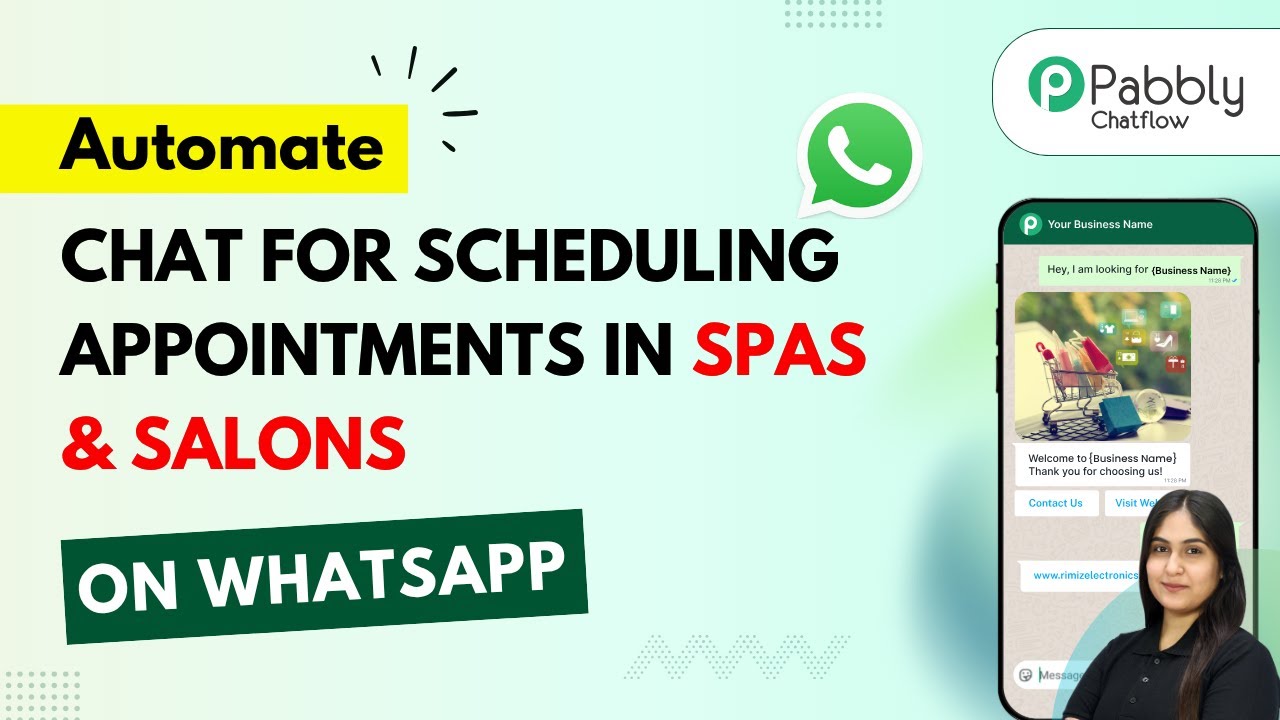
Automate Appointment Scheduling for Beauty Salons on WhatsApp Using Pabbly Chatflow

Learn how to automate appointment scheduling for beauty salons on WhatsApp using Pabbly Chatflow. Follow these detailed steps for seamless integration. Master conversational marketing with practical techniques for creating chatbots that engage visitors at exactly the right moment in their journey.

Watch Step By Step Video Tutorial Below


1. Accessing Pabbly Chatflow for Appointment Scheduling

To automate appointment scheduling for beauty salons using Pabbly Chatflow, start by accessing the platform. Visit the Pabbly Chatflow website and sign in or create a new account if you are a first-time user. using Pabbly Connect

Once logged in, you will be directed to your dashboard where you can manage your AI assistants. Pabbly Chatflow is the central hub for integrating WhatsApp with your appointment scheduling system.


2. Setting Up WhatsApp Integration with Pabbly Chatflow

After accessing your Pabbly Chatflow account, the next step is to set up WhatsApp integration. This is essential for automating communications with your clients. Click on the ‘Add WhatsApp Number’ button located at the top right corner of your dashboard. using Pabbly Connect

  • Select the preferred method for WhatsApp connection.
  • Follow the prompts to complete the connection process.
  • Ensure you have your WhatsApp Business Account details ready.

By integrating WhatsApp with Pabbly Chatflow, you enable automatic responses and appointment scheduling directly through your WhatsApp communication.


3. Creating an AI Assistant for Your Salon

Once WhatsApp integration is complete, you can create an AI assistant to handle client queries and schedule appointments. Click on the ‘Add AI Assistant’ button in your Pabbly Chatflow dashboard. Provide a name for your assistant, such as ‘Radiant Glow’. using Pabbly Connect

Select the type of instructions for your AI assistant. For appointment scheduling, choose the AI agent type. This configuration allows your assistant to respond to client messages effectively.

  • Set the temperature for responses to control creativity.
  • Choose the AI model based on your needs.
  • Input your API key from OpenAI to enable functionalities.

With these settings, your AI assistant will be ready to manage appointments and respond to client inquiries on WhatsApp.


4. Configuring Assistant Settings in Pabbly Chatflow

After creating your AI assistant, it’s crucial to configure its settings to ensure it operates smoothly. Navigate to the assistant settings and set your header and footer messages that will be displayed to clients. using Pabbly Connect

Additionally, you can add initial messages that the assistant will send when a client initiates a chat. For example, set a message like, ‘Hello! How can I assist you today?’ This helps in engaging clients right from the start.

Enable AI auto-reply settings for seamless communication. Customize fallback messages for unrecognized queries. Set knowledge sources to provide accurate information to clients.

These configurations ensure that your AI assistant is effective in managing client interactions and scheduling appointments efficiently.


5. Testing Your AI Assistant on WhatsApp

Once your AI assistant is fully configured, it’s time to test its functionality. Send a message to your connected WhatsApp number, such as ‘I need help with booking an appointment.’ Your AI assistant should respond automatically with relevant information. using Pabbly Connect

For instance, it might reply with a message detailing the services offered, pricing, and available appointment slots. This demonstrates how Pabbly Chatflow facilitates seamless communication and appointment scheduling.

Ensure to test various queries to confirm that your AI assistant handles them effectively. If adjustments are needed, revisit the Pabbly Chatflow settings to refine responses and improve user experience.


Conclusion

Automating appointment scheduling for beauty salons on WhatsApp using Pabbly Chatflow is a straightforward process. By following these steps, you can enhance client engagement and streamline your booking system effectively.

Ensure you check out Pabbly Connect to create business automation workflows and reduce manual tasks. Pabbly Connect currently offer integration with 2,000+ applications.

How to Send Personalized WhatsApp Offers to Repeat Stripe Customers Using Pabbly Connect

Learn how to automate sending personalized WhatsApp offers to repeat Stripe customers using Pabbly Connect. Step-by-step tutorial included. Learn to create powerful connections between your critical applications without requiring specialized programming knowledge or extensive technical background.

Watch Step By Step Video Tutorial Below


1. Accessing Pabbly Connect for Integration

To send personalized WhatsApp offers to repeat Stripe customers, you first need to access Pabbly Connect. Start by visiting the Pabbly Connect website and either sign in or create a new account.

Once logged in, you will see the Pabbly Connect dashboard. Here, you can create a new workflow to integrate Stripe with WhatsApp. This integration will allow you to automate the sending of offers to your customers based on their payment activities.


2. Creating a New Workflow in Pabbly Connect

Next, you will create a workflow in Pabbly Connect to set up the automation. Click on the ‘Create Workflow’ button located at the top right corner of the dashboard. You will be prompted to name your workflow.

  • Enter a name for your workflow, such as ‘Send Personalized WhatsApp Offers to Repeat Stripe Customers’.
  • Select a folder to save your workflow, or create a new one if needed.
  • Click on the ‘Create’ button to proceed.

After creating the workflow, you will be taken to the workflow builder where you can set up triggers and actions to automate the process of sending WhatsApp messages.


3. Setting Up the Trigger for Stripe Payments

In this step, you will set up the trigger for your workflow using Pabbly Connect. Select ‘Stripe’ as your trigger application and choose the event ‘New Charge’. This event will trigger the workflow whenever a new payment is received.

After selecting the event, click on the ‘Connect’ button to link your Stripe account with Pabbly Connect. You will need to copy the webhook URL provided by Pabbly Connect and set it up in your Stripe account to receive payment notifications.

  • Log in to your Stripe account and navigate to the ‘Developers’ section.
  • Select ‘Webhooks’ and click on ‘Add Endpoint’.
  • Paste the copied webhook URL and select the ‘Charge.succeeded’ event.

After setting up the webhook, you can test the connection to ensure that Pabbly Connect is receiving data from Stripe correctly.


4. Retrieving Customer Data from Stripe

Now that the trigger is set up, the next step is to retrieve customer data from Stripe using Pabbly Connect. Add an action step to your workflow and select ‘Stripe’ again as the action application. This time, choose the event ‘Get Customer by Email’.

In this action step, you will map the email address of the customer from the previous step to retrieve their details. This allows you to get the customer’s phone number, which is necessary for sending WhatsApp messages.

Select the existing connection to Stripe in Pabbly Connect. Map the email address from the trigger step to the email field in this action step. Click on ‘Save & Send Request’ to retrieve the customer data.

Once the customer data is retrieved, you will have access to their phone number, which will be used in the next step to send the WhatsApp message.


5. Sending the WhatsApp Message

In the final step, you will send the personalized WhatsApp message using Pabbly Connect. Add another action step and select ‘WhatsApp Cloud API’ as the action application. Choose the event ‘Send Template Message’.

Here, you need to configure the message template that you want to send to your customers. Ensure that you use the phone number retrieved in the previous step and map it to the recipient’s phone number field.

Select the template you created for sending offers. Map the customer’s name and any other dynamic fields to personalize the message. Click on ‘Save & Send Request’ to send the message.

After completing this step, your automated workflow is set up! Whenever a new payment is received in Stripe, a personalized WhatsApp message will be sent to the customer automatically, enhancing customer loyalty and engagement.


Conclusion

In this tutorial, we have demonstrated how to use Pabbly Connect to send personalized WhatsApp offers to repeat Stripe customers. By following these steps, you can automate your communication process and improve customer retention effectively.

Ensure you check out Pabbly Connect to create business automation workflows and reduce manual tasks. Pabbly Connect currently offer integration with 2,000+ applications.

How to Send Bulk Webinar Invitations Automatically Using Gmail for Google Form Leads

Learn how to send bulk webinar invitations automatically using Gmail for Google Form leads with Pabbly Connect. Follow this step-by-step tutorial for seamless integration. Explore efficient methods for automating routine tasks with clear, concise instructions suited for both newcomers and experienced professionals.

Watch Step By Step Video Tutorial Below


1. Accessing Pabbly Connect for Webinar Invitations

To send bulk webinar invitations automatically using Gmail for Google Form leads, you first need to access Pabbly Connect. Start by opening your browser and searching for ‘Pabbly.com/connect’. This will take you to the Pabbly Connect landing page.

Once on the landing page, you will see options to either sign in or sign up for free. If you are a new user, click on the ‘Sign up for free’ button to get started. Existing users can simply click on ‘Sign In’ to access their accounts. Once signed in, navigate to the Pabbly Connect dashboard to begin creating your workflow.


2. Creating a Workflow in Pabbly Connect

After accessing the Pabbly Connect dashboard, the next step is to create a new workflow. Click on the ‘Create Workflow’ button and choose the ‘New’ option for a modern interface. Enter a name for your workflow, such as ‘Send Bulk Webinar Invitations Automatically Using Gmail for Google Form Leads’, and select a folder to save it in.

  • Click on ‘Create’ to open the workflow window.
  • In the workflow window, you will set up a Trigger and Action.
  • Select Google Forms as the trigger application.

Once you have set up the trigger, you will be ready to connect Google Forms with Gmail using Pabbly Connect. This integration allows you to automate the sending of webinar invitations seamlessly.


3. Setting Up the Trigger with Google Forms

To set up the trigger in Pabbly Connect, click on the ‘Add Trigger’ button and select Google Forms as your trigger application. For the trigger event, choose ‘New Response Received’. After that, connect your Google account and allow permissions as prompted.

Pabbly Connect will provide you with a Webhook URL. Copy this URL and navigate to your Google Forms. Ensure that the last question in your form is marked as required so that it can serve as the trigger column for your responses.

  • Link your Google Form to a Google Sheets spreadsheet.
  • Install the Pabbly Connect Webhooks add-on in your Google Sheets.
  • Paste the Webhook URL into the initial setup of the add-on.

Once you have completed these steps, your Google Forms will be successfully connected to Pabbly Connect, ready to capture new responses automatically.


4. Sending Automated Emails via Gmail

After setting up the trigger, the next step is to send automated emails to registrants using Gmail. In your Pabbly Connect workflow, click on ‘Add Action Step’ and select Gmail as the action application. For the action event, choose ‘Send Email V1’.

Connect your Gmail account by selecting ‘Add a New Connection’ and signing in with your Google account. Once connected, you will need to map the recipient’s email address from the previous step’s response. This allows the email to be sent to the correct registrant automatically.

Fill in the sender’s name, subject, and email content. Use HTML format for attractive email content. Test the email by clicking on ‘Save and Send Test Request’.

Once you have tested your email, you will see the confirmation that the email has been sent successfully. This completes the setup for sending bulk webinar invitations using Pabbly Connect.


5. Testing the Automation

To ensure that your automation is working correctly, conduct a test submission through your Google Form. Fill out the form with dummy data and submit it. After submitting, check your Gmail inbox to see if the automated email has been received.

If everything is set up correctly, you will receive an email with the webinar invitation shortly after submitting the form. This demonstrates that Pabbly Connect is effectively capturing the form responses and triggering the email action as intended.

Now, you can confidently use this automation for your webinars. With Pabbly Connect, you can streamline your workflow and ensure that every registrant receives their invitation automatically, enhancing your webinar management process.


Conclusion

Using Pabbly Connect to send bulk webinar invitations automatically via Gmail for Google Form leads simplifies the registration process. By following this detailed tutorial, you can efficiently set up your automation and enhance your webinar outreach.

Ensure you check out Pabbly Connect to create business automation workflows and reduce manual tasks. Pabbly Connect currently offer integration with 2,000+ applications.

How to Use Pabbly Chatflow for Scheduling Appointments via WhatsApp Chatbot

Learn how to effectively use Pabbly Chatflow to create a WhatsApp chatbot for scheduling appointments in spas and salons. Follow this detailed tutorial for seamless integration.

Watch Step By Step Video Tutorial Below


1. Getting Started with Pabbly Chatflow

To use Pabbly Chatflow for scheduling appointments, first, access the platform by visiting Pabbly Chatflow at Pabbly.com. Once there, sign up or log into your account to begin creating your WhatsApp chatbot.

Pabbly Chatflow allows you to connect your WhatsApp account seamlessly. After logging in, you can set up your WhatsApp number by clicking on the ‘Add WhatsApp Number’ button. This is crucial for enabling communication through the chatbot.


2. Creating Your WhatsApp Chatbot in Pabbly Chatflow

Once your WhatsApp number is connected, you can start building your chatbot. In Pabbly Chatflow, click on the ‘Add Flow’ button to create a new flow for your WhatsApp chatbot. Name your flow appropriately, such as ‘WhatsApp Chatbot for Scheduling Appointments’.

  • Select a trigger event for your flow.
  • Choose keywords or regex patterns to activate the chatbot.
  • Design the response messages for user interactions.

After naming your flow, you will be prompted to set up triggers for your chatbot. This is where you define what messages will activate the chatbot, ensuring it responds to customer inquiries about appointment scheduling.


3. Configuring Appointment Scheduling with Pabbly Chatflow

Next, you need to configure the appointment scheduling process within the chatbot. In Pabbly Chatflow, create a list of services offered, such as massages and facials. You can do this by dragging and dropping the list component into your flow.

  • Add items to your services list with descriptions.
  • Include options for customers to select their desired treatment.
  • Set up follow-up questions to gather user details like name and preferred appointment time.

This setup allows customers to choose their preferred treatment and provide necessary details, which will be captured in your Google Sheets through Pabbly Connect integration.


4. Integrating Google Sheets with Pabbly Chatflow

To store appointment details, integrate Google Sheets with your Pabbly Chatflow setup. In your Pabbly account, navigate to Pabbly Connect and create a new workflow that connects your WhatsApp chatbot to Google Sheets. using Pabbly Connect

Select Pabbly Chatflow as the trigger application and choose the event as ‘New Message Received’. This will ensure that every time a customer books an appointment, their details are automatically recorded in your Google Sheets.


5. Testing Your WhatsApp Chatbot Integration

After completing the setup, it’s essential to test your WhatsApp chatbot to ensure it works as intended. Send a message to your WhatsApp number using the phrase you defined as a keyword to trigger the chatbot.

Check the responses and ensure that the appointment details are being recorded in your Google Sheets correctly. This final testing phase is crucial to confirm that your Pabbly Chatflow integration is functioning seamlessly.


Conclusion

In this tutorial, we explored how to use Pabbly Chatflow to create a WhatsApp chatbot for scheduling appointments in spas and salons. By following these steps, you can automate your appointment booking process effectively.

Ensure you check out Pabbly Connect to create business automation workflows and reduce manual tasks. Pabbly Connect currently offer integration with 2,000+ applications.

How to Send Automated WhatsApp Messages After Facebook Lead Ads Using Pabbly Connect

Learn how to use Pabbly Connect to send automated WhatsApp messages after collecting leads from Facebook Lead Ads. Step-by-step tutorial included. Explore systematic approaches to creating efficient automation solutions that convert technical concepts into practical, implementable instructions.

Watch Step By Step Video Tutorial Below


1. Accessing Pabbly Connect for Automation

To send automated WhatsApp messages after Facebook Lead Ads, you’ll first need to access Pabbly Connect. Start by visiting the Pabbly website and signing up for an account if you haven’t already. Once you have an account, log in to access the dashboard.

After logging in, you will see various applications provided by Pabbly. Click on the Pabbly Connect option to begin setting up your automation process for sending WhatsApp messages.


2. Creating a New Workflow in Pabbly Connect

In Pabbly Connect, you can create a new workflow to automate the sending of WhatsApp messages. Click on the ‘Create Workflow’ button to start. You will be prompted to name your workflow, for example, ‘Send WhatsApp Messages After Facebook Lead Ads’.

  • Choose a meaningful name for your workflow.
  • Select the trigger event as ‘Facebook Lead Ads’.
  • Connect your Facebook account through Pabbly Connect.

After naming your workflow, click on the ‘Create’ button. This will take you to the workflow setup page where you can define your trigger and action events.


3. Setting Up Facebook Lead Ads as Trigger

In this section, you will set up the trigger for your workflow. Select ‘Facebook Lead Ads’ as your app, and then choose ‘New Lead’ as the trigger event. This ensures that every time a new lead is generated, it will activate your workflow in Pabbly Connect.

Next, you will need to connect your Facebook account. Click on ‘Add New Connection’ and follow the prompts to log in and authorize Pabbly Connect to access your Facebook Lead Ads. Once connected, select the specific Facebook page and lead form you want to use.

  • Choose the Facebook page linked to your ads.
  • Select the lead ad form that captures user details.

After setting these parameters, it’s important to test the connection by submitting a dummy lead to ensure that everything is working correctly.


4. Setting Up WhatsApp as Action

With your trigger set, the next step in Pabbly Connect is to define the action, which will send the WhatsApp message. Select ‘WhatsApp Cloud API’ as your action app and choose ‘Send Template Message’ as the action event.

Now, you will need to connect your WhatsApp Cloud API account. Click on ‘Add New Connection’ and enter the required details such as your WhatsApp Business Account ID and token. This connection is crucial for sending messages through WhatsApp.

Input your WhatsApp Business Account ID. Provide the token generated from your WhatsApp API. Map the recipient’s phone number from the lead data.

Once you have configured the WhatsApp connection, customize your message template and ensure all required fields are filled out. Finally, save your settings and test the action to confirm that the WhatsApp message is sent successfully.


5. Finalizing Your Automation Process

After successfully setting up both the trigger and action in Pabbly Connect, it’s time to finalize your automation. Ensure that all connections are tested and functioning correctly. You can do this by submitting another test lead through your Facebook Lead Ads.

Check your WhatsApp to see if the automated message is received. If everything works as expected, your automation is now complete! You can sit back and let Pabbly Connect handle the communication with your leads automatically.

Remember that you can always return to Pabbly Connect to make adjustments to your workflow as necessary. This flexibility allows you to optimize your messaging strategy over time.


Conclusion

In this tutorial, we demonstrated how to use Pabbly Connect to send automated WhatsApp messages after collecting leads from Facebook Lead Ads. By following these steps, you can streamline your communication with potential customers effectively.

Ensure you check out Pabbly Connect to create business automation workflows and reduce manual tasks. Pabbly Connect currently offer integration with 2,000+ applications.

Utilizing Pabbly Connect not only saves time but also enhances customer engagement through timely responses. Start automating your workflows today for better business efficiency!

Automate Client Onboarding via Email After Payment from Razorpay Using Pabbly Connect

Learn how to automate client onboarding via email after payment from Razorpay using Pabbly Connect. Step-by-step guide for seamless integration. Master proven automation processes with practical implementation examples and strategic recommendations you can apply immediately in your workflow.

Watch Step By Step Video Tutorial Below


1. Setting Up Pabbly Connect for Automation

To automate client onboarding via email after payment from Razorpay, you first need to access Pabbly Connect. Start by visiting the Pabbly Connect website and signing up for an account. If you’re a new user, you can sign up for free and receive 100 tasks every month.

Once logged in, navigate to the Pabbly Connect dashboard where you can create and manage your automation workflows. Click on the ‘Create Workflow’ button located in the top right corner to begin your setup.


2. Creating the Workflow in Pabbly Connect

After clicking ‘Create Workflow’, you will be prompted to name your workflow. Enter a name such as ‘Automate Client Onboarding via Email After Payment from Razorpay’. Next, select a folder to organize your workflow, which helps in managing multiple automations within Pabbly Connect.

  • Click on the ‘Create’ button to finalize your workflow setup.
  • Ensure the workflow is activated by toggling the button on.

Now you can add a trigger for your automation. Click on ‘Add Trigger’ and select Razorpay as your trigger app. Choose the event ‘Payment Captured’ to initiate the workflow whenever a payment is made.


3. Configuring Razorpay in Pabbly Connect

Once Razorpay is selected, you will receive a webhook URL from Pabbly Connect. This URL acts as a bridge between Razorpay and Pabbly Connect. Copy this URL, as you will need to paste it into your Razorpay account.

Log in to your Razorpay dashboard and navigate to the ‘Developer’ section. Here, select ‘Webhooks’ and click on ‘Add New Webhook’. Paste the copied URL and select the event ‘Payment Captured’. After entering a secret, click ‘Create Webhook’ to save your settings.


4. Testing the Integration with a Sample Payment

After configuring Razorpay, it’s time to test the integration. Go back to the Razorpay dashboard and initiate a test payment. Fill in the required details and complete the payment process. This action will trigger the webhook, sending payment details to Pabbly Connect.

Once the payment is confirmed, return to Pabbly Connect where you should see a response containing the payment details. This indicates that the integration is working correctly, and you can now proceed to set up the email action.

  • Ensure that the payment details are correctly captured in the Pabbly Connect response.
  • This response will be used to send the onboarding email.

Next, select Gmail as the action app to send an email to the customer who made the payment.


5. Sending the Onboarding Email via Gmail

In the action step, choose Gmail and then select the event ‘Send Email’. Connect your Gmail account to Pabbly Connect by clicking on ‘Add New Connection’ and signing in with your Google account.

Now, map the fields from the Razorpay response to the email fields. For example, map the recipient’s email address, the subject, and the email content. Make sure to personalize the email by including the customer’s name and the amount they paid.

Include a friendly greeting in the email content. Add a closing statement inviting the customer to reach out with questions.

Finally, test the email action to ensure that the onboarding email is sent successfully to the customer’s Gmail account. Once confirmed, your automation is complete!


Conclusion

By following these steps, you can effectively automate client onboarding via email after payment from Razorpay using Pabbly Connect. This integration streamlines your processes and enhances the client experience without manual intervention. Start leveraging automation today for a smoother workflow!

Ensure you check out Pabbly Connect to create business automation workflows and reduce manual tasks. Pabbly Connect currently offer integration with 2,000+ applications.

How to Save LinkedIn Leads into Notion CRM with Timestamp Using Pabbly Connect

Learn how to integrate LinkedIn leads into Notion CRM with timestamps using Pabbly Connect. Follow our step-by-step tutorial for seamless automation. Explore systematic approaches to creating efficient automation solutions that convert technical concepts into practical, implementable instructions.

Watch Step By Step Video Tutorial Below


1. Accessing Pabbly Connect for Integration

To save LinkedIn leads into Notion CRM with timestamps, you first need to access Pabbly Connect. This platform allows seamless integration between various applications, including LinkedIn and Notion.

Visit the Pabbly Connect homepage by entering the URL in your browser. You can sign up for free, which gives you access to 100 tasks every month. Once logged in, you can start creating your workflows.


2. Creating a Workflow in Pabbly Connect

After accessing Pabbly Connect, the next step is to create a workflow to automate the process of saving leads. Click on the ‘Create Workflow’ button located in the top right corner.

  • Select the Classic workflow builder option.
  • Choose LinkedIn as your trigger application.
  • Set the trigger event to ‘Lead Notifications’.

Once you have set up the trigger, Pabbly Connect will listen for new leads coming from LinkedIn. This is a crucial step in automating your lead management.


3. Authorizing LinkedIn in Pabbly Connect

To proceed, you need to authorize your LinkedIn account within Pabbly Connect. Click on the ‘Connect with LinkedIn’ button, and ensure you are logged into your LinkedIn account.

After successful authorization, select your LinkedIn account from the options provided. This step ensures that Pabbly Connect can access your lead data. Once connected, you will be able to receive lead notifications directly into your workflow.


4. Setting Up Notion to Receive Leads

Next, set up Notion as the action application within Pabbly Connect. Choose Notion and then select the action event as ‘Create Database Item’. This will allow you to store the lead details in your Notion CRM.

  • Select the database you want to use for storing leads.
  • Map the lead details from LinkedIn to the corresponding fields in Notion.
  • Ensure to include the timestamp for when the lead was generated.

By mapping these fields correctly, Pabbly Connect ensures that every new lead is automatically added to your Notion database with all necessary details, including the timestamp.


5. Testing the Integration

Once you have set up the integration, it’s essential to test it to ensure everything works as expected. Generate a test lead in your LinkedIn account and check if the details are captured in Notion.

After generating the test lead, return to Pabbly Connect and check the workflow for the response. If successful, you will see the lead details populated in your Notion database. This confirms that your automation is functioning correctly.


Conclusion

In this tutorial, we explored how to save LinkedIn leads into Notion CRM using Pabbly Connect. By following these steps, you can efficiently automate your lead management process and ensure that all relevant information, including timestamps, is captured seamlessly.

Ensure you check out Pabbly Connect to create business automation workflows and reduce manual tasks. Pabbly Connect currently offer integration with 2,000+ applications.

How to Enroll Students into Graphy from Google Sheets Entry Using Pabbly Connect

Learn how to enroll students into Graphy from Google Sheets using Pabbly Connect. This step-by-step tutorial covers integration setup and automation processes. Revolutionize your productivity approach with just a few strategic clicks. Uncover professional methods for connecting applications and creating workflows that reclaim hours of your week.

Watch Step By Step Video Tutorial Below


1. Accessing Pabbly Connect for Integration

To enroll students into Graphy from Google Sheets, you first need to access Pabbly Connect. Start by visiting the Pabbly website and signing in to your account. If you’re a new user, you can create a free account to explore the features.

Once logged in, navigate to the Pabbly Connect dashboard. Here, you will find options to create new workflows and manage existing ones. This platform is essential for integrating Google Sheets with Graphy, automating the enrollment process seamlessly.


2. Creating a Workflow in Pabbly Connect

In this step, you will create a new workflow in Pabbly Connect. Click on the ‘Create Workflow’ button located at the top right corner of the dashboard. You will be prompted to name your workflow, so enter a name like ‘Enroll Students from Google Sheets’.

  • Select the folder where you want to save this workflow.
  • Choose the ‘New Beta’ option for a modern interface.

After naming your workflow, proceed to set up the trigger. You will select Google Sheets as your trigger application and choose the event as ‘New or Updated Spreadsheet Row’. This setup allows Pabbly Connect to monitor your Google Sheets for any new student entries.


3. Connecting Google Sheets to Pabbly Connect

Next, you need to connect your Google Sheets to Pabbly Connect. Copy the webhook URL provided by Pabbly Connect after setting up your trigger. Now, head over to your Google Sheets account and install the Pabbly Connect add-on if you haven’t already.

After installation, refresh your Google Sheets. Click on the Extensions menu, select Pabbly Connect, and then select ‘Initial Setup’. Enter the copied webhook URL and specify the trigger column, which should be the last data column in your sheet. This setup ensures that every new entry in the specified column sends data to Pabbly Connect.


4. Creating a Learner in Graphy

With your Google Sheets connected, the next step is to create a learner in Graphy using Pabbly Connect. For this, select Graphy as your action application and choose the event as ‘Create Learner’. This action will utilize the data collected from Google Sheets.

In this step, you will map the data from your Google Sheets to the required fields in Graphy. For example, map the first name, last name, and email address from the Google Sheets entry to the corresponding fields in Graphy. Ensure all required fields are filled correctly to avoid errors.


5. Enrolling the Learner in a Course

Finally, you will enroll the newly created learner into a specific course in Graphy. Use Pabbly Connect to select the action event as ‘Enroll Learner to Course’. Here, you will need to provide the learner’s email and the course URL.

To get the course URL, navigate to your Graphy account, select the course you want the learner to enroll in, and copy the URL. Paste this URL into the corresponding field in Pabbly Connect, ensuring that the learner is enrolled successfully in the desired course.

Conclusion

This guide summarizes the key points and helps you understand the essential features and benefits of using this tool.

Ensure you check out Pabbly Connect to create business automation workflows and reduce manual tasks. Pabbly Connect currently offer integration with 2,000+ applications.


In conclusion, this tutorial provides a detailed guide on how to enroll students into Graphy from Google Sheets using Pabbly Connect. By following these steps, you can automate the enrollment process, ensuring that every new student entry is captured and enrolled seamlessly. For further assistance, refer to the Pabbly community or support resources.

How to Send Custom Product Recommendations via Email After WooCommerce Purchase Using Pabbly Connect

Learn how to automate sending custom product recommendations via email after WooCommerce purchases using Pabbly Connect. Step-by-step guide included. Develop expertise in application integration and learn how to design streamlined automation workflows using proven, simplified approaches.

Watch Step By Step Video Tutorial Below


1. Accessing Pabbly Connect for WooCommerce Automation

To send custom product recommendations via email after a WooCommerce purchase, you first need to access Pabbly Connect. Start by visiting the Pabbly website and signing in to your account. If you don’t have an account, you can sign up for free and get 100 tasks monthly.

Once logged in, navigate to the Pabbly Connect dashboard. Here you can create a new workflow. Click on the ‘Create Workflow’ button and select the classic workflow builder for ease of use. Name your workflow something like ‘Send Custom Product Recommendations via Email After WooCommerce Purchase’ to keep it organized.


2. Setting Up WooCommerce as a Trigger in Pabbly Connect

In this step, set up WooCommerce as the trigger application in Pabbly Connect. This means that whenever a new order is created in WooCommerce, it will trigger the automation. Choose WooCommerce from the list of apps and select the trigger event as ‘New Order Created’.

  • Select WooCommerce as your trigger application.
  • Choose ‘New Order Created’ as the trigger event.
  • Connect WooCommerce to Pabbly Connect using the provided webhook URL.

To connect WooCommerce, log in to your WordPress dashboard, navigate to the WooCommerce settings, and find the Webhooks section under advanced settings. Here, add a new webhook by pasting the URL provided by Pabbly Connect and activating it. This establishes a connection to automate the workflow.


3. Generating Product Recommendations with OpenAI in Pabbly Connect

After setting up WooCommerce, the next step is to generate custom product recommendations using OpenAI within Pabbly Connect. Select OpenAI as the action application and choose the action event as ‘Chat GPT Structured AI Output’. This will allow Pabbly Connect to create personalized recommendations based on the order details.

To connect OpenAI, you will need an API token. Generate a new API key in your OpenAI account and paste it into Pabbly Connect. Ensure that the AI model selected is appropriate for your needs, such as GPT-4 Mini.

  • Select OpenAI as the action application.
  • Choose ‘Chat GPT Structured AI Output’ as the action event.
  • Enter your API token to connect OpenAI to Pabbly Connect.

In the prompt section, create a message that includes customer details and the purchased product. For example, you can ask OpenAI to recommend accessories that complement the purchased item. This personalized touch enhances customer engagement.


4. Sending Customized Emails via Gmail through Pabbly Connect

Once the product recommendations are generated, the next step is to send these recommendations via email using Gmail integrated with Pabbly Connect. Select Gmail as the action application and choose ‘Send Email V1’ as the action event. This allows you to automate the email sending process.

Connect your Gmail account to Pabbly Connect by granting the necessary permissions. After connecting, fill in the email fields using the mapped data from the previous steps. This includes the recipient’s email address, subject, and email body, which contains the product recommendations generated by OpenAI.

Select Gmail as your action application. Choose ‘Send Email V1’ as the action event. Map the email fields using the data from WooCommerce and OpenAI.

After entering all the required details, click on ‘Save and Send Test Request’ to ensure that the email is sent successfully. You will receive a confirmation response indicating the email was sent, and you can check your Gmail inbox to verify.


5. Finalizing the Automation Workflow in Pabbly Connect

In this final step, review the entire workflow created in Pabbly Connect. You have successfully set up an automation that triggers when a new order is placed in WooCommerce, generates product recommendations using OpenAI, and sends an email via Gmail.

Make sure to test the entire process by placing a new order in your WooCommerce store. This will help you confirm that all connections are working correctly and that the email with product recommendations is sent as expected. You can refine the prompts or email content as needed based on the feedback received.

By using Pabbly Connect, you have streamlined your e-commerce operations, saving time and enhancing customer satisfaction through personalized communication. This automation not only improves efficiency but also builds better relationships with your customers.


Conclusion

In summary, automating the process of sending custom product recommendations via email after WooCommerce purchases using Pabbly Connect enhances your e-commerce operations. By integrating WooCommerce, OpenAI, and Gmail through Pabbly Connect, you can provide personalized experiences for your customers effortlessly.

Ensure you check out Pabbly Connect to create business automation workflows and reduce manual tasks. Pabbly Connect currently offer integration with 2,000+ applications.

How to Send Custom Welcome Emails After Registration via Google Forms Using Pabbly Connect

Learn how to automate sending custom welcome emails after registration using Google Forms and Pabbly Connect. Step-by-step guide with specific instructions. Revolutionize your productivity approach with just a few strategic clicks. Uncover professional methods for connecting applications and creating workflows that reclaim hours of your week.

Watch Step By Step Video Tutorial Below


1. Accessing Pabbly Connect for Automation

To start sending custom welcome emails after registration via Google Forms, you need to access Pabbly Connect. Open a new tab and navigate to the Pabbly Connect website. Once there, you can either sign up for a new account or sign in if you already have one.

After signing in, you will land on the Pabbly Connect dashboard. Here, you can manage all your automation workflows. Click on the ‘Create Workflow’ button located at the right-hand corner to initiate the setup for sending welcome emails.


2. Creating a New Workflow in Pabbly Connect

In this section, we will create a new workflow in Pabbly Connect that will allow us to automate the sending of welcome emails. After clicking on ‘Create Workflow’, you will be prompted to select between the new version or the classic version. Choose the new version for a more flexible experience.

Next, you will see a dialog box asking for a workflow name and folder selection. Name your workflow something like ‘Send Custom Welcome Emails After Registration via Google Form’ and select a folder for organization. Click on the ‘Create’ button to proceed. Your workflow will now be created successfully.

  • Open Pabbly Connect and sign in.
  • Click on ‘Create Workflow’.
  • Select the new version for a better experience.

After creating the workflow, toggle the button to activate it. You can now add a trigger, which will start the automation process.


3. Setting Up Google Forms as a Trigger

In this step, we will set up Google Forms as the trigger in Pabbly Connect. Click on the ‘Add Trigger’ option and search for Google Forms. Select it and choose the event ‘New Response Received’. After this, click on the ‘Connect’ button.

You will be provided with a webhook URL, which acts as a bridge between Google Forms and Pabbly Connect. Copy this URL as you will need it to link your Google Form. Next, go to your Google Form and navigate to the responses section to link it with a Google Sheet.

  • Select Google Forms as the trigger app.
  • Choose ‘New Response Received’ as the event.
  • Copy the webhook URL provided by Pabbly Connect.

Now, go back to your Google Form, link it to a Google Sheet, and ensure that the data from the form responses will be recorded there.


4. Configuring Google Sheets to Capture Responses

After linking your Google Form to a Google Sheet, you need to configure it to work seamlessly with Pabbly Connect. Open the Google Sheet and navigate to the ‘Extensions’ section. Here, search for ‘Pabbly Connect Webhooks’ and install it if you haven’t already.

Once installed, go back to the ‘Extensions’ menu, select ‘Pabbly Connect Webhooks’, and click on ‘Initial Setup’. Paste the webhook URL you copied earlier and select the trigger column, which should be the last column of your data. Click on ‘Send Test’ to ensure everything is working correctly.

Install Pabbly Connect Webhooks from Google Sheets Extensions. Paste the webhook URL in the Initial Setup. Select the last column as the trigger column.

After testing the configuration, you should see a successful response in Pabbly Connect, confirming that your Google Sheet is now set up to capture responses from the Google Form.


5. Sending Custom Welcome Emails via Gmail

The final step in this automation process involves sending custom welcome emails using Gmail through Pabbly Connect. Click on the plus icon to add an action step and search for Gmail. Select it and choose the action event ‘Send Email’.

Connect your Gmail account by selecting ‘Add New Connection’. After successfully connecting, you will need to fill in the recipient’s email address, subject line, and email content. You can dynamically map fields from the Google Form response to personalize the email, such as including the user’s name and the workshop category they selected.

Select Gmail as the action app. Choose ‘Send Email’ as the action event. Map the fields to personalize the email content.

After filling in all necessary fields, click on ‘Save and Send Test Request’. You should receive a confirmation that the email has been sent successfully, completing the automation process.


Conclusion

In this tutorial, we have demonstrated how to use Pabbly Connect to automate sending custom welcome emails after registration via Google Forms. By following these steps, you can create a seamless experience for your users, ensuring they receive personalized communication right after registration.

Ensure you check out Pabbly Connect to create business automation workflows and reduce manual tasks. Pabbly Connect currently offer integration with 2,000+ applications.

Utilizing Pabbly Connect not only saves time but also enhances user engagement with tailored messages that set the right tone from the start.